IB Physics Topic 2 Notes
B1: Thermal energy transfers
Phases of matter
In Topic A.3, considerable time was taken in expanding on the types of energy you will encounter during IB physics. However, when considering the behavior of energy and how it transfers between objects, you need to understand how the particles within objects behave to store and release energy.
To begin, remember that each object can present itself as a state of matter (solid, liquid or gas) but can switch between them. The kinetic theory governs the properties of each phase: solids, liquids, and gases.
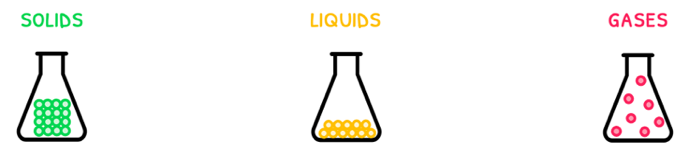
- Solids have a fixed volume and shape because their particles vibrates around a fixed position held there by strong intermolecular forces. This is typically the densest phase.
- Liquids have a fixed volume and fill the shape of their container, because their particles slide over one another due to weaker intermolecular force. This phase typically has an intermediate density.
- Gases do not have a fixed volume and fill the shape of thier container, because their particles move randomly in space due to their very weak intermolecular forces. This phase typically has the lowest density.
Note that density is the ratio of mass to volume. The formula for this is:
Temperature
Now it is common sense that what separates solids from liquids from gases is temperature. Relative to one another, you might assume that a solid is cold, a liquid is warm, and a gas is hot. What is less obvious is what temperature means.
An object's temperature (T) is the average kinetic energy of all its particles. So, the faster particles in an object move, the warmer the object is, and the colder particles in an object, the colder the object is.
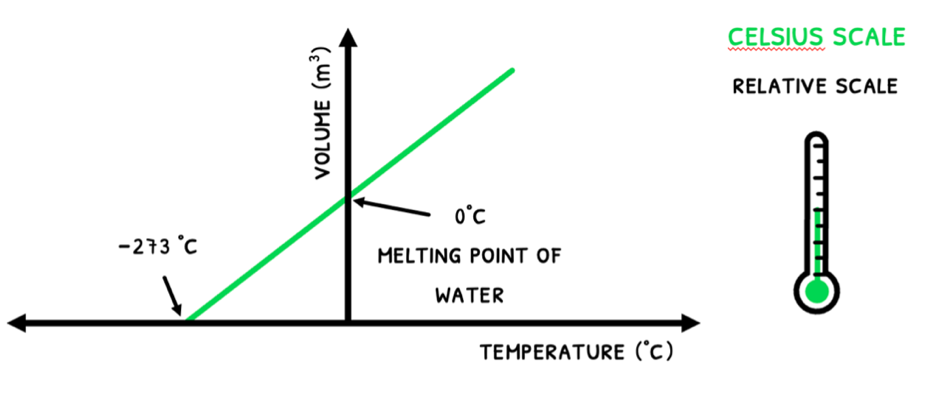
In day-to-day situations, temperature is commonly measured in Celsius (°C). This is a scale based off water, where 0°C is the melting/freezing point of water and 100°C is the boiling/condensing point of water. However, this is not a very scientific way to measure kinetic energy.
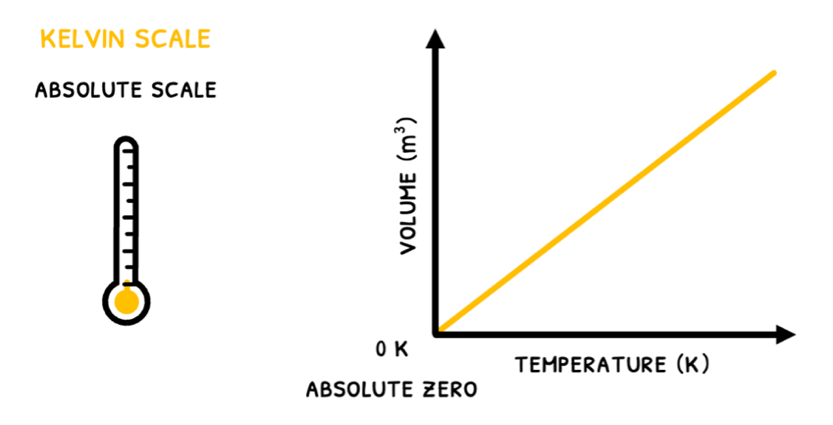
As a result, the Kelvin scale was created. This measures temperature in Kelvin (K), based off 0 K being absolute zero, the coldest possible temperature. At this point, the particle have zero kinetic energy.
B3: Gas laws
Moles
In Topic B.1, you learned about phases, phase changes, and heat transfer of substances. Whilst it is easy to perform experiments measuring these phenomena in solids and liquids due to their finite volume, it completely changes in gases.
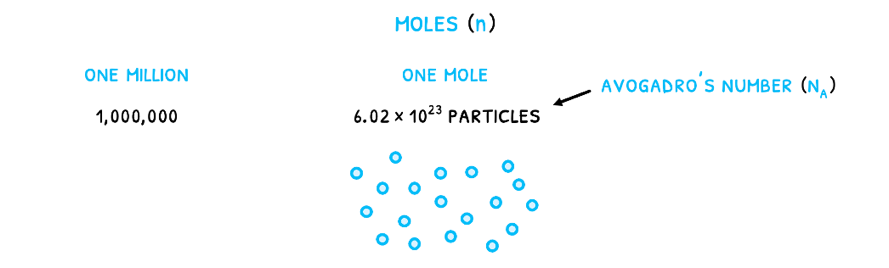
The change is that gases cannot easily be measured by their mass or volume. As a result, they are measured in moles (n). This is a measure of the number of particles given by Avogadro’s number (NA) equal to 6.022 x 10²³ particles/mole. It relates to the number of particles that would make Carbon-12 exactly 12 grams as the standard element. Therefore, just like one million is 1,000,000, one mole is 6.022 x 10²³ particles. For any number of particles (N), to calculate the number of moles, use the formula:
Note that this describes the number of particles so 1 mole of any diatomic molecule, such as H2, has 1.2044 x 1024 atoms because every molecule (and therefore particle) has two component atoms.
The mass of an atom can be expressed as molar mass (M), the mass of one mole of a substance in gmol-1. Calculating molar mass is possible with the formula:
Pressure
Once you know how many moles of gas you have, you can then start to analyze its behavior when changing several variables, including pressure, temperature, and volume.
Whilst we know now what temperature is, and the concept of volume is straightforward, we don't know much about what pressure is yet.
In IB physics, you are supposed to understand that the amount of pressure a gas inside a container experiences is related to the force of the particle collisions with the container walls and the number of collisions per area. To easily digest this concept, think of getting poked and bumped.
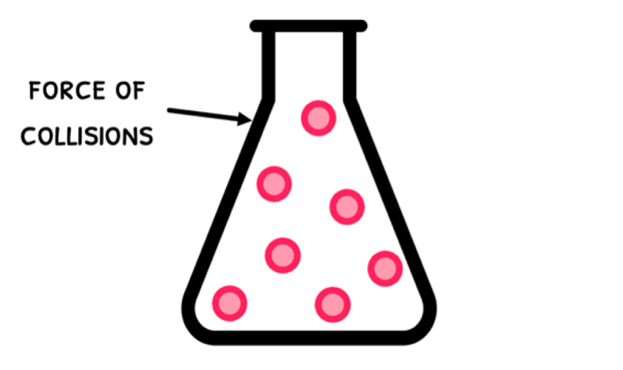
- If you get poked softly, you don't feel much pressure. If you get poked hard, suddenly you feel the pressure. The same occurs with particles - collisions with little force don't exert much pressure whereas collisions with high force do exert considerable pressure.
- However, now compare poking and bumping with the same force. A soft bump would result in less pressure than a soft poke because it is spread out over a larger area. The same occurs with particles - less collisions over the same area result in a lower pressure than many collisions over the same area.
Therefore, pressure is the force per unit area of the container. The formula for this is:
However, whenever a force is exerted on the container to cause this pressure, the particle transfers energy to the container. This change in energy is related to a change in speed and thus momentum of the particle. As a result, pressure can also be defined in terms of the change of momentum. The formula for this is:
B5: Current & circuits
Voltage
Topic B.5 primarily focuses on electricity, which is the movement of charges. Their movement is brought about by the electric force, and in Topic D.2 you will learn about electric fields that exert this electric force. However, you will learn the basics before this. Remember from Topic A.2 that when an object moves in the direction of an applied force, work is being done on the object. So, if a test charge in an electric field moves in the direction of the exerted electric force, work is done on the charge.
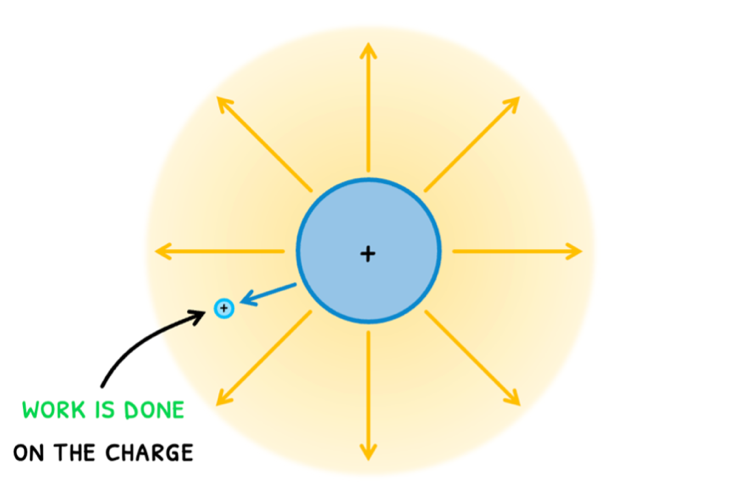
This is the voltage (V), officially defined as the work done per unit charge and measured in Volts (V). The formula for this is:
However, voltage typically applies to large scale movements of electrons. When work is done on a single electron, it is measured in electronvolts (eV). To convert, moving an electron through 1 Volt is 1eV, which is equal to 1.6 x 10⁻¹⁹ J.
You may also hear voltage referred to as potential difference (pd), and you can use both terms interchangeably. However, let's explain the term nonetheless:
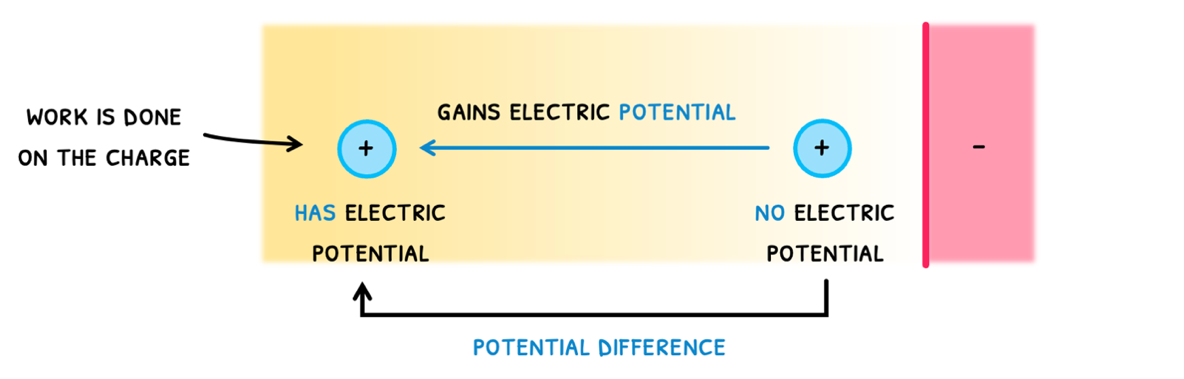
- If you place test charge right next to a charge distribution and then move it, we know that work is being done on the test charge.
- As a result, the test charge gains energy, called its electric potential energy or electric potential.
- Right next to the charge distribution, it had no electric potential, but further away from it, it now has electric potential.
- It is this change in potential that is called the potential difference.
However, this is functionally the same as voltage and thus both terms can be used. It should be noted that potential difference is more often used when discussing individual charge movement, whilst voltage is more often used when discussing circuits.