IB Physics Sub-topic A1 Notes
This page contains our IB Physics notes for sub-topic A1. By reading each one of these notes, you will fully cover the content for IB Physics 'Kinematics & motion'.
Loading progress...
Properties of motion
In Topic A.1, you need to focus on kinematics - the movement of objects, or motion. This is a fundamental concept in physics, and can be described with several terms:
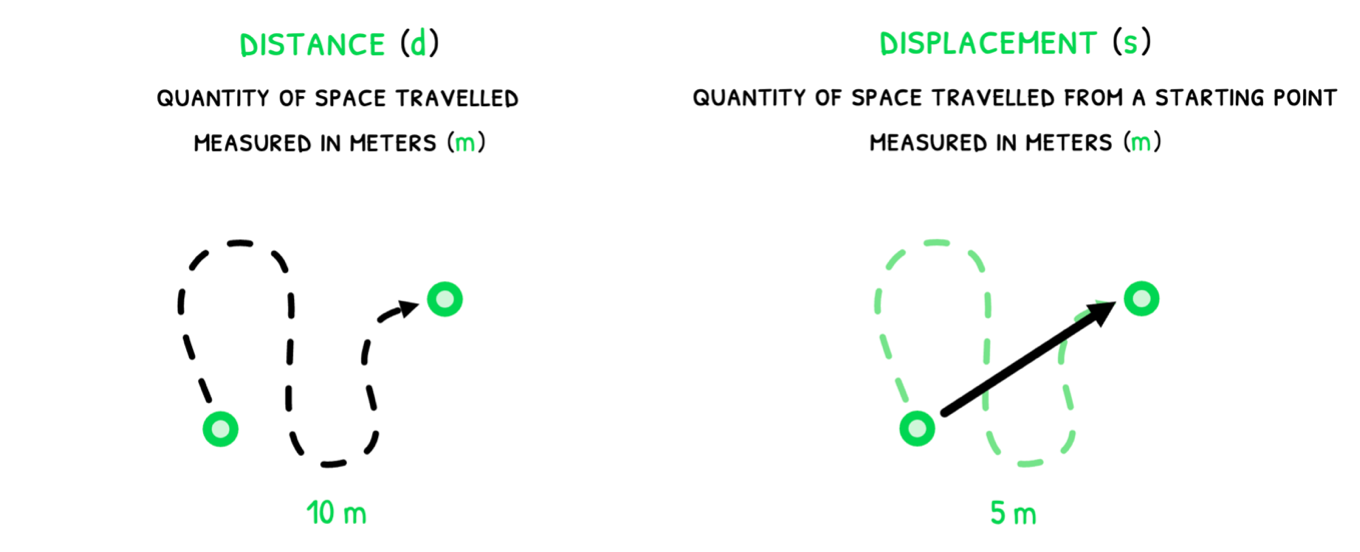
- distance (d) – the amount of space travelled, measured in m.
- displacement (s) – the net distance an object has travelled from its starting point in a direction, measured in m.
- speed (v or u) – the distance travelled per unit time, measured in m s-1. v refers to the final speed and u to the initial speed.
- velocity (v or u) – the displacement per unit time, measured in m s-1. v refers to the final velocity and u to the initial velocity.
- acceleration (a) – the velocity travelled per unit time or displacement travelled per square unit time, measured in m s-2.
The matching equations are:
Remember that displacement, velocity, and acceleration are vectors, whereas speed is a scalar and is directionless.
An object’s measured velocity is also dependent on how it is measured and what it is measured in reference to. In motion experiments, velocity or acceleration are measured via:
- light gates – a gate emits a beam of light and can calculate the average speed of the object based on how long it breaks the beam or how long it takes to travel between two gates.
- strobe photography – light flashes at a set rate in front of a camera, capturing the object’s motion in pictures.
tibertutor.com
Great Work!
You have now covered all of our sub-topic A1 notes, covering "Kinematics & motion" for IB physics.
Now that you have completed these IB physics sub-topic A1 notes, covering "Kinematics & motion", dive into our sub-topic A1 flashcards for the IB physics course.
IB physics sub-topic A1 flashcards
Explored IB Physics?
Get stuck into one of our other subjects!
Join 85,000 students, across 130+ countries, in 500+ IB schools. That's half of the IB science graduates worldwide.
Start a 7d free trial