IB Physics Sub-topic C1 Notes
Formulae of simple harmonic motion
In Topic C.1 HL, you need to be able to quantify the displacement, velocity, and acceleration and the energies. To fully understand how this occurs, let's first review how these are related. Remember that the phase difference between displacement and velocity is 90°, velocity and acceleration is 90°, and displacement and acceleration is 180° as shown below:

Since simple harmonic motion is sinusoidal motion, an alternative way to describe the displacement, velocity, and acceleration is via trigonometric functions. The basic format of these is:
- a sin bx
- a cos bx
Here, a is amplitude and b is the period coefficient, whose corresponding values are shown below:
| Amplitude (a) | Period coefficient (b) | |
|---|---|---|
| Displacement (x) | maximum displacement (x0) | angular frequency (ω) |
| Velocity (v) | maximum velocity (v0) = ωx0 | angular frequency (ω) |
| Acceleration (a) | maximum acceleration (a0) = ω2 x0 | angular frequency (ω) |
Substituting in these values, the formulae we get are:
No displacement at t = 0 | Positive displacement at t = 0 | ||
|---|---|---|---|
| Displacement (x) | |||
| Velocity (v) | |||
| Acceleration (a) | |||
Also remember that kinetic and potential energy are continually transferred during simple harmonic motion to conserve the total energy, as shown below:
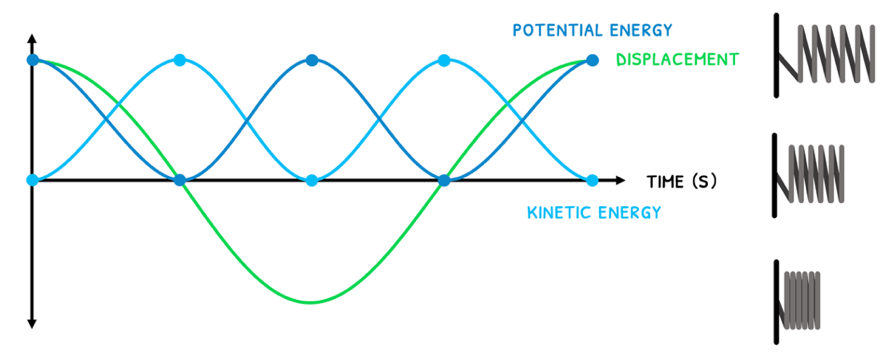
The key formulas are:
- Kinetic energy
- Potential energy
- Total energy
As such, the key relationships are that at:
- Maximum displacement - maximum potential energy and zero kinetic energy. Therefore, total energy is equal to potential energy.
- Zero displacement - maximum kinetic energy and zero potential energy. Therefore, total energy is equal to kinetic energy
- Minimum displacement - maximum potential energy and zero kinetic energy. Therefore, total energy is equal to potential energy