IB Physics Sub-topic C1 Notes
Oscillations
A core concept in IB physics is that of oscillations: which are the continual movement of an object around a fixed point, called its equilibrium position. You are expected to know five more properties of oscillations: displacement, amplitude, wavelength, period, and frequency.
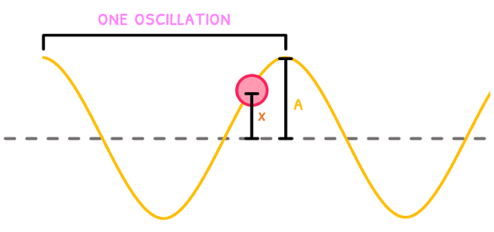
- The displacement of the object (x) is the distance of the particle from its equilibrium position, measured in meters
- The amplitude of the oscillation (a) is the maximum or minimum displacement of the particle, also measured in meters
- The length of one oscillation is visible from crest to crest, or trough to trough, and can be defined by three terms: wavelength, period, frequency, and angular frequency:
- Wavelength (λ) is defined as the length of one oscillation, measured in meters
- Period (T) is defined as the time it takes to complete one oscillation, measured in seconds
- Frequency (f) is defined as the number of oscillations that occur in one second, measured in Hertz (Hz)
- Angular frequency (ω) is defined as the angular displacement of an oscillation in one second, measured in radians per second
Since angulary frequency, frequency, and period both measure oscillations in terms of time, they are related. The formula for this is:
Now that you know the properties of oscillations, we can discuss the two different types:
- Periodic - waves with a constant frequency and period.
- Aperiodic - waves with multiple frequencies or periods.
Path and phase difference
The IB expects you to be able to predict what happens when waves interact. For this to be possible, you are only expected to consider periodic waves of the same frequency.
How they subsequently interact is dependent on their alignment, termed the the path difference (p) or phase difference (ø). These mean the same thing but have different units. This comparison is possible because the waves look like sine or cosine functions. Since they will have the same frequency, you can compare where the crests of one wave are relative to the other wave:
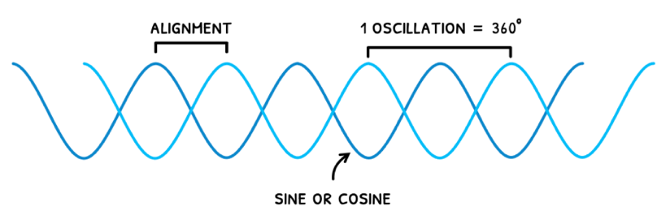
- The path difference is measured in number of wavelengths. Being ahead or behind one wavelength means the path difference is 1λ.
- The phase difference is measured in degrees or radians. Being ahead or behind one wavelength means the phase difference is 360° or 2π.