IB Physics Sub-topic C3 Notes
Wave diagrams
In Topics C.1 and C.2, you learned about oscillations, simple harmonic motion, and the types and properties of waves. In this topic, you cover the behavior of wavefronts. To understand this visually, this first starts by understanding how to visually represent waves. This can be done one of two ways:
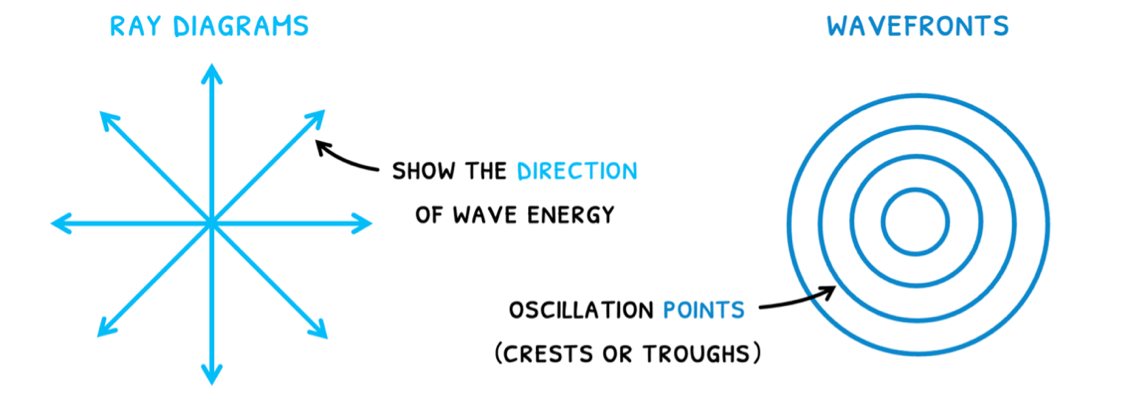
- Ray diagrams – here, arrows show the direction in which the wave energy travels.
- Wavefront diagram – here, circles show the oscillation points of waves moving together i.e. crests or troughs.
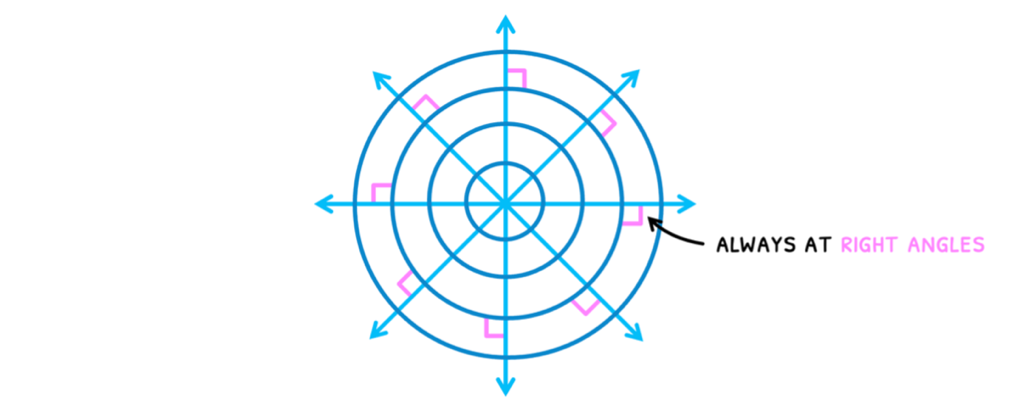
Often these are combined into one diagram, as shown below. However, note that rays and wavefronts are always at right angles to one another.
Wavefront behavior
Now knowing how to draw waves, we can discuss how these waves interact with matter. Its interaction can be one of three types: reflection, refraction, or diffraction.
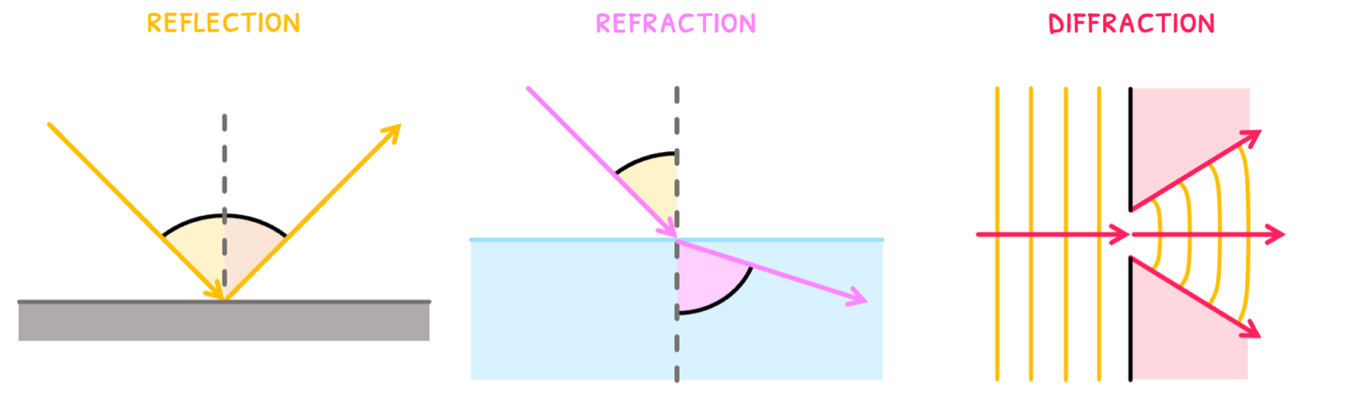
The way in which these occur, however, depends on the type of wave:
- In most waves, energy is transferred through large particles. As a result, the energy absorption properties of surface particles determine the observed interaction.
- However, in electromagnetic waves, energy is transferred through electrons. Each electron oscillates in place and re-emits a secondary wave. As a result, the interference patterns of these emitted waves determines the observed interaction.
Reflection
Let's start reviewing the phenomenon of reflection. This is defined as the scattering of a wave when it hits the surface of a medium. This can occur in two ways:
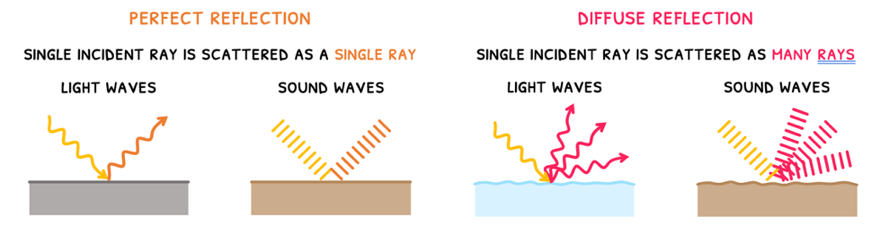
- Perfect reflection is when a single incident ray is scattered as a single ray.
- For light waves, this typically occurs with smooth metallic surfaces. This is because free electrons in the metal re-emit waves that destructively interfere with the incident wave and produce a reflection.
- For sound waves, this typically occurs with smooth hard surfaces. This is because their particles cannot absorb the energy and vibrate well, instead reflecting it.
- Diffuse reflection is when a single incident ray is scattered as many rays.
- For light waves, this typically occurs with rough non-metallic surfaces. This is because non-metals have internal structural irregularities that cause multiple reflections, and rough surfaces have external irregularities that cause multiple reflections.
- For sound waves, this typically occurs with rough hard surfaces. This is because hard materials reflect sound and rough surfaces reflect in multiple directions, both previously discussed.