IB Physics Sub-topic D4 Notes
Electromotive force
Now that you know how electromagnetic fields function, you need to understand how they are manipulated to our advantage via a process called induction.
To start, remember that the electromotive force (emf or ε) is the total energy difference per unit charge, measured in volts (V). However, it can be induced in a conductor with no current when it crosses magnetic flux lines. There are two principal ways in which this can happen:
- Moving a conductor through a magnetic field.
- Rotating a conductor through a magnetic field.
When moving part of a conductor through a magnetic field, the gain in magnetic potential energy induces a magnetic force (Fm) and electric force (Fe). Lenz’s law states that this induced magnetic field produces an electromotive force (ε) that opposes its original motion (v) through the magnetic field. This scenario is shown below:
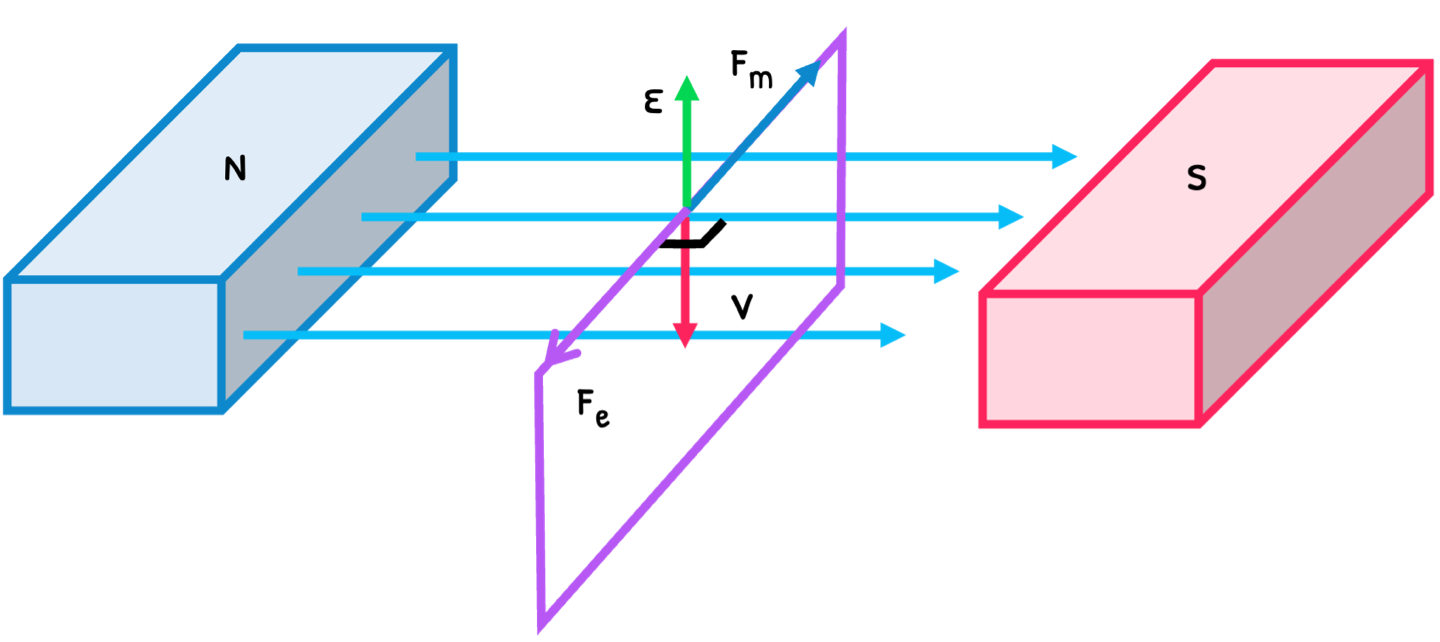
The induced electromotive force is thus dependent on magnetic field strength (B), conductor speed (v) and length (L). The formula is thus:
Flux
The magnetic field can also be drawn as a cross-section, with x’s representing flux lines into the page and dots representing flux lines out of the page. The same scenario is cross-section is shown below:

Since flux density is the equivalent of magnetic field strength, the formula for flux (Φ), measured in Webers (Wb) is:
If the area is at an angle to the field, the formula is:
Thus, an alternative definition of electromotive force is the rate of change of flux. Therefore, the formula can be rewritten as: