IB Biology Sub-topic B4.1 Notes
Habitats
Next up, you need to learn about habitats and how organisms make a living in an ecosystem. A habitat is officially defined as the place where a community, species, or organism lives. This can typically be described by the geographical and physical location and the type of ecosystem.
Each habitat is thus defined by its abiotic factors. To understand this, remember that ecosystems are composed of two types of factors:
- Biotic factors - these are living things, such as animals, plants, or bacteria.
- Abiotic factors - these are non-living things, such as water, air, and the sun.
Biotic factors can be further sub-divided into three categories:
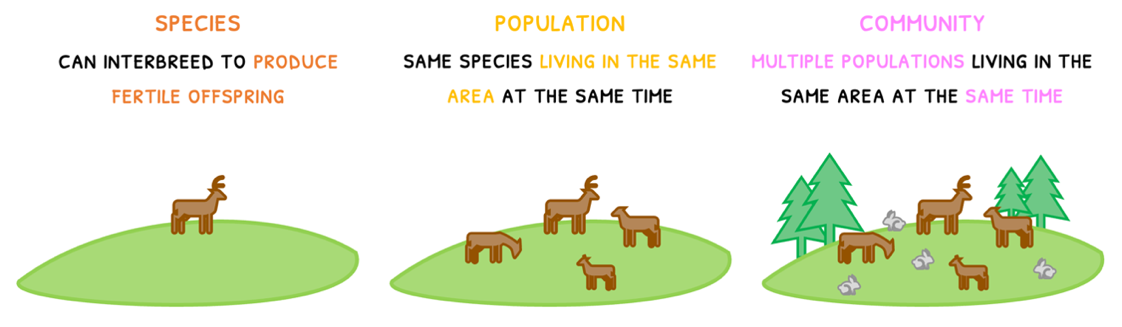
- Species - a group of organisms that can produce fertile offspring.
- Population - a group of organisms of the same species living in the same area at the same time.
- Community - multiple populations living in the same area at the same time.
Effect of abiotic factors
Since abiotic factors in a habitat are typically unchanging, organisms living in that habitat must be adapted to these abiotic factors. Two examples you are expected to remember are marram grass in dunes and mangrove trees.
Marram grass's adaptations include:
- Hairs on the underside of the leaf to reduce wind speed, and thus transpiration.
- Thin rolled leaves, creating a moist humid environment around the stomata by reducing exposure to wind. This decreases the concentration gradient, thus reducing transpiration.
- An extensive root system to reach all available water and increase water uptake.
- Thick waxy cuticle and few stomata to reduce water loss.
- Small spongy mesophyll airspaces to maintain humidity in the leaf with little water, decreasing the amount that can be lost.
The adaptations of mangrove trees include:
- Very small leaves that can shed when water is scarce, decreasing transpiration.
- Sunken stomata to enable the ability to store water in leaves.
- Long root systems to remove salt build-up and reach all available water.
- Sugar and K+ storage in the cytoplasm, as well as Na+ and Cl- in vacuoles, thus maintaining a hypertonic internal environment. This prevents the osmosis of internal water out to the saline water.
Range of tolerance
However, species are never perfectly adapted and can only survive some variation in that habitat, called its range of tolerance. This impacts the region of the habitat that the animal will inhabit and changes with genetics, age, and health status. The wider an organism's range of tolerance, the greater their ability to survive and thrive, and thus the greater their distribution. A habitat distribution will clearly demarcate the tolerance of an organism:
- At the optimum tolerance range, the conditions are perfect for the organism to thrive and they are most abundant here.
- When there greater variation in the conditions, organisms enter the stress zone, where there mental and physical health takes a toll. Thus, less organisms will be found here.
- At the extremes, the zones of intolerance begin. No organisms exist here because the conditions are too hostile for the organism to survive at all.
However, most organisms tend to have a narrow optimum range wherein function best. This varies from organism to organism, species to species, and may vary during development or seasonally.
The range of tolerance is thus a limiting factor for a species's existence in a habitat. You must be able to measure the range of tolerance using a transect, which is a line positioned to span a community of organisms. Transect sampling provides information about a species distribution along an environmental gradient such as across a seashore, or up a mountains slope. There are three main types of transect:
Point sampling on a line - in this transect, sample points are evenly distributed along a line transect. At each sample point, the abundance of an organism is measured to determine its habitat distribution.
Continuous belt - in this transect, there are infinite sample points along a belt transect (also has width), and thus the abundance of an organism is measured across the whole belt.
Interrupted belt - in this transect, the belt transect is divided into evenly distributed zones across the length and into quadrants across the width. In each quadrant, the abundance of an organism is measured.
Using transects, an organism's distribution can be estimated.