IB Biology Sub-topic D4.3 Notes
Climate change
You are likely familiar with climate change as a concept, and need to know more about it in this topic. It is defined as an extreme change in climate conditions due to changing global conditions. This disruption to our climate is commonly attributed to human activity. However, there is still opposition to this so let's review the evidence for and against climate change.
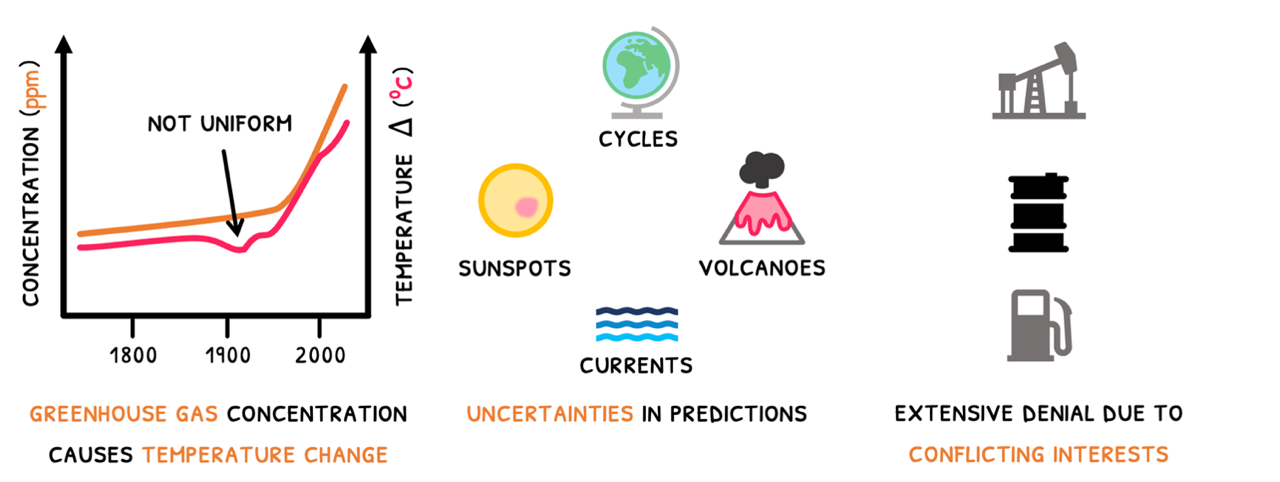
- Drilling into ice from thousands of years definitively shows a strong association between atmospheric carbon dioxide and global temperature.
- Natural processes such as Milankovitch cycle, sunspot activity, ocean currents, and volcanoes all contribute to the climate.
- Carbon dioxide has naturally fluctuated throughout history due to shifting tectonic and volcanic activity.
- Additionally, global warming does not increase uniformly whereas carbon dioxide concentration does.
- However, carbon dioxide concentration has drastically increased since the 1950s at a historic rate.
- This coincides with the additional mass burning of fossil fuels by humans, and the associated increase in temperature.
There is extensive denial on this evidence due to conflicting interests, especially from companies that profit from fossil fuels. However, all the evidence has been analysed by many climate change scientists, who have almost unanimously concluded that climate change is an anthropogenic process.
Global warming
Evidence shows that climate change is a direct result of global warming due to the enhanced greenhouse effect. Due to continuous carbon emissions and the positive feedback of the greenhouse effect on global warming, this unfortunately creates more positive feedback loops that have led to the increase in both CH4 and CO2 gases in the atmosphere. You are expected to understand how the different positive lead to this:
- The albedo effect - sea ice has a high reflectivity or ‘albedo’ and this helps maintain cold temperatures. However, climate change has caused sea ice to retreat, exposing non-reflective surfaces. Heat is absorbed not reflected and this further warm both the air and sea. Symptomatic of these events, there is currently less and thinner sea ice.
- Water vapor release - climate change has led to warmer temperatures, in turn leading to higher rates of evaporation from surface waters. This increases the amount of atmospheric water vapor, contributing to the greenhouse effect, trapping heat energy in the atmosphere, culminating in erratic weather events.
- Release of CO2 from deep oceans - dead microorganisms on the ocean floor sediments transport carbon. Stored as CO2 in freezing conditions and under pressure, warming oceans release the formerly stable stored CO2 into the ocean, and it is eventually released from the water surface to the atmosphere, contributing to the greenhouse effect.
- Release of methane from permafrost - large quantities of methane are stored underground in the polar regions and also under the ocean as clathrates. Global warming is causing the permafrost to thaw out, causing methanogenesis, releasing methane to the atmosphere. Thawing clathrates directly release methane gas.
- Increases in droughts and forest fires - the increased temperatures apparent in climate change are causing droughts. Such conditions cause vegetation and dead material on forest floors to dry out and increase the risk of forest fires. Wildfires themselves involve the combustion of plant material and the release of large quantities of CO2 into the atmosphere. If such fires are located near ice or snow, the soot and smoke released can reduce the albedo.
Thus, each of these events exemplify positive feedback loops that drive climate change by increasing greenhouse gas emissions, driving further global warming, and further exacerbation of these same issues.