IB Biology Sub-topic A4.1 Notes
Types of speciation
At this point, you have heard of reproductive isolation leading to speciation a few times. You need to understand that the type of isolation influences the type of speciation:
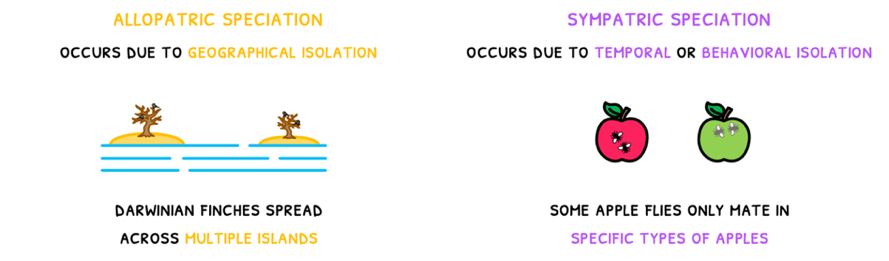
- Allopatric speciation - this is speciation that occurs due to geographical isolation. An example would be the Darwinian finches, spread across multiple islands. Interestingly, this therefore creates multiple gene pools for a single species.
- Sympatric speciation - this is speciation that occurs due to temporal or behavioural isolation. An example would be apple flies, where the hawthorn and non-hawthorn varieties only mate in specific types of apples, despite living in the same area.
The type of isolation influences how and how long speciation occurs for, but eventually the two populations evolve to exhibit different characteristics. Over a sufficient time period, the two populations cannot interbreed to produce fertile offspring, and are thus classed as two different species.
Adaptive radiation
As a result of reproductive isolation, it is evident that species may develop into radically different organisms, even if they live in the same area. This normally occurs via adaptive radiation. Remember that this is the evolution of homologous structures for different function, such as the pentadactyl limb in whales for swimming and bats for flying.
The important concept to remember is that if two species speciate within the same area, they still compete with one another for resources. If there are vacant niches present within the community, the species that is outcompeted is more likely to undergo adaptive radiation and fill this niche. As a result, the two separated species can co-exist in the same ecosystem and increase its biodiversity!
Hybridization
However, equally important in speciation is the maintenance of reproductive isolation. Hybridization is the production of offspring from two different species. In closely related species there are mechanisms that maintain reproductive isolation after fertilization, called post-zygotic isolating mechanisms. There are two main methods to consider:
Hybrid inviability
This method aims to impede zygotic development. Thus, when a zygote is produced, its genetic incompatibility may arrest its development. This can occur due to different chromosome numbers between the two species, such as sheep and goats. Sheep have 54 chromosomes, and goats 60 chromosomes so if they mate, any offspring are typically stillborn.
Hybrid sterility
If two species mate and can produce offspring, the species may be reproductively isolated if the offspring produced are sterile. This is seen in mules, the product of a horse and a donkey and in zebronkeys the product of a cross between a zebra and a donkey. This cannot continue the genetic line and effectively halts hybridization.