IB Chemistry Sub-topic S2.2 Notes
Covalent Bonds
The next intramolecular bond to learn is the covalent bond. This is defined as the electrostatic attraction between a pair of nuclei and their shared pair of electrons. This is the strongest type of intramolecular bond and typically occurs between non-metals.
During a single covalent bond, two electron orbitals with one electron each overlap so that the electrons are paired in what is known as a molecular orbital. The remaining pairs of electrons are left in the valence shell of the atoms involved and become known as “lone pairs”.
There are three types of covalent bonds:
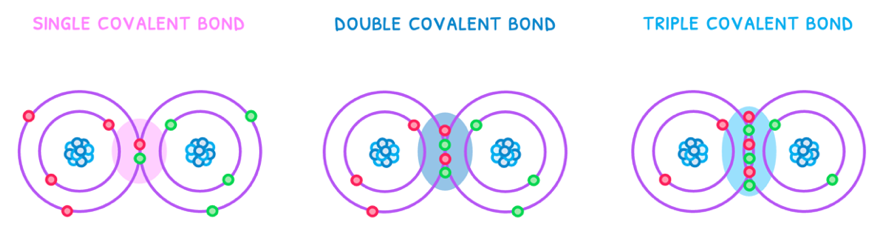
- Single - one pair of electrons is shared. This is therefore the weakest and longest bond.
- Double - two pairs of electrons are shared. This is therefore the bond of intermediate strength and length.
- Triple - three pairs of electrons are shared. This is therefore the strongest and shortest bond.
This is summarized in the table below:
| Bond type | Bond strength | Bond length |
|---|---|---|
| single | weakest | longest |
| double | intermediate | intermediate |
| triple | strongest | shortest |
Coordinate Covalent Bonds
Whilst the pair of electrons contained within a covalent bond generally come one from each atom, this is not always the case. In a coordinate bond, also called a dative covalent bond, a single atom donates both electrons. Once this bond forms, it is identical to a regular covalent bond, the only difference is the origin of the electron pair.
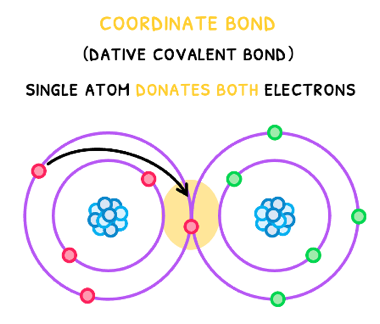
When a coordinate covalent bonds occurs between two molecules, this forms an adduct.
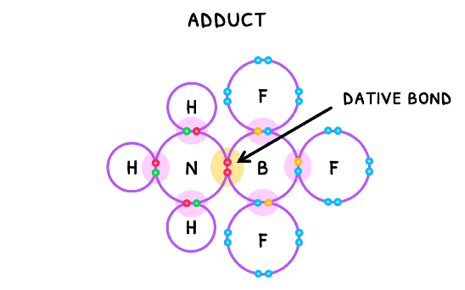
An example is NH3 and BF3. Here, the the Nitrogen atom within NH3 donates a lone pair to BF3, forming a dative bond.