IB Chemistry Sub-topic S1.1 Notes
This page contains our IB Chemistry notes for sub-topic S1.1. By reading each one of these notes, you will fully cover the content for IB Chemistry 'Particulate matter'.
Loading progress...
Types of matter
To begin chemistry, it is important to understand that matter can appear as three types of substances: elements, compounds, and mixtures.
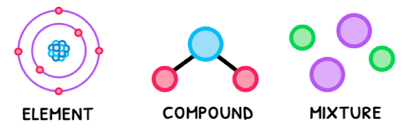
- Elements are the simplest substances made of atoms that cannot be broken down.
- Compounds are substances made up of two or more atoms chemically bonded in fixed ratios and have different properties than their components.
- Mixtures are substances made up of more than one element or compound not chemically bonded together so that they retain their individual properties. There are two different types of mixtures:
- Homogeneous – the components of the mixture are uniformly distributed. They thus cannot be distinguished from one another. This often occurs when two components are in the same state (such as water & alcohol), but this may not always be the case (such as water & oil).
- Heterogeneous – the components of mixture are not uniformly distributed. They thus can be distinguished from one another. This often occurs when two components are in different states (such as water & sand), but again, this may not always be the case (such as water & sugar).
In chemistry you often need to deal with pure substances, but most substances are found as mixtures in nature. You are expected to be aware of six separation techniques for mixtures: solvation, filtration, recrystallization, evaporation, distillation, and paper chromatography.
- Solvation dissolves a solid mixture in a solvent. The solvent molecules dissolve the soluble substance, leaving behind the insoluble substance. For example, salt in a mixture of sand and salt can be dissolved by adding water. This dissolves the salt and separates it from the sand, which remains undissolved.
- Filtration separates a mixture containing solids via a filter. Depending on the size of the pores, the filter allows liquids, gases, and small solid particles to pass through, but traps larger solid particles. For example, a mixture of water, sand, and rocks can be separated using a paper filter to filter through the water, and a small pore strainer to filter through the sand, leaving the rocks behind.
- Recrystallization splits a solid mixture by solubility at different temperatures. The mixture is dissolved in a hot solvent, and the solution slowly cooled. As the solution cools, the less soluble solids crystallize first and can be physically removed. For example, in a mixture of salt, sugar, and hot water, sugar is more soluble than salt. Thus, as the solution cools back down, the salt will recrystallize first, allowing for it to be filtered out of the solution.
- Evaporation removes a solvent from a mixture based on its volatility. The mixture is heated to the point of vaporization, where the liquid solvent vaporizes into the atmosphere and leaves the solute behind. For example, to produce salt, seawater is collected in shallow pools and left to evaporate, leaving behind the salt.
- Distillation is used to separate liquid mixtures based on their boiling points. The mixture is heated to the lowest boiling point, causing that liquid to vaporize and condense back into a liquid in the condenser. For example, in a mixture of ethanol and water, heating the mixture to 78°C will evaporate only the ethanol, which is condensed and collected in another beaker.
- Chromatography separates components of a mixture based on their solubility and affinity to paper and a specific solvent. Generally, the more soluble the component, the higher on the paper they rise, allowing for each component to be identified. The specifics of chromatography are covered in more detail in Topic 2.2.
tibertutor.com
Great Work!
You have now covered all of our sub-topic S1.1 notes, covering "Particulate matter" for IB chemistry.
Now that you have completed these IB chemistry sub-topic S1.1 notes, covering "Particulate matter", dive into our sub-topic S1.1 flashcards for the IB chemistry course.
IB chemistry sub-topic S1.1 flashcards
Explored IB Chemistry?
Get stuck into one of our other subjects!
Join 85,000 students, across 130+ countries, in 500+ IB schools. That's half of the IB science graduates worldwide.
Start a 7d free trial