IB Chemistry Sub-topic R3.4 Notes
Lewis Theory
In Topic R3.1, the ionic and Brønsted-Lowry theories of acids and bases were introduced. In the HL syllabus, you need to know the third theory: Lewis theory.
In this theory, there are also two principles:
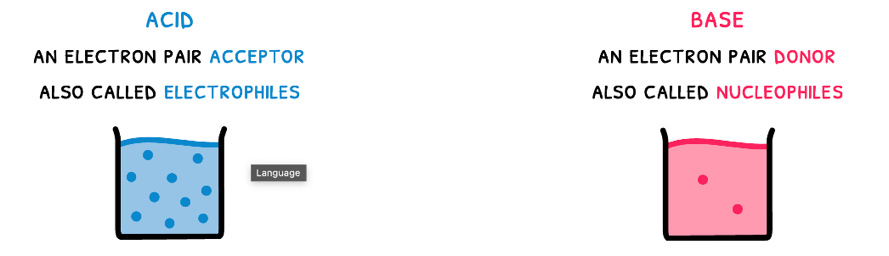
- An acid is a species that accepts a pair of electrons. This is due to their high electronegativity, so they are attracted to negative charges. They are termed electrophiles.
- A base is a species that donates a pair of electrons. This is due to their low electronegativity, so they are attracted to positive charges. They are termed nucleophiles.
Common Lewis acids and bases are shown in the table below:
| Lewis acids | Lewis bases |
|---|---|
BF3 H+ CH3+ | NH3 H2O OH- |
Amphoteric and Amphiprotic
You will find that the Brønsted-Lowry theory and Lewis theory are often used alongside one another depending on what is being donated/accepted, so you need to be familiar with them both.
When it comes to using both, however, two terms need to be defined:
- Amphiprotic - these substances are able to both accept and donate a proton. By definition these act as both a Brønsted-Lowry acid and base.
- Amphoteric - these substance are able to act as both an acid and a base.
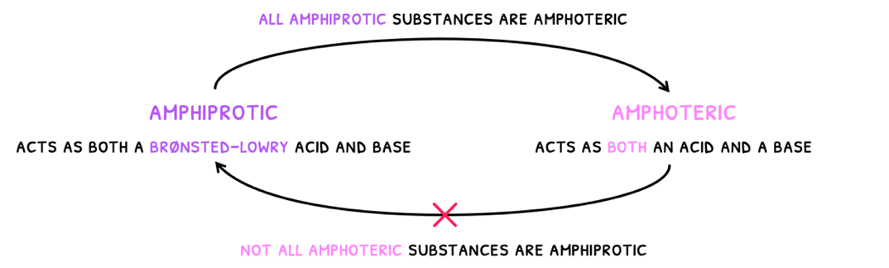
As a result, a species that can act as both a Lewis acid and bases would be amphoteric but not amphiprotic. You can thus say that:
- All amphiprotic substances are amphoteric.
- Not all amphoteric substances are amphiprotic.
More electron-pair sharing
Now that you are familiar with Lewis theory, you need to understand how Lewis acids and bases are involved in reactions. To finish the syllabus, you are expected to know more detail about the three remaining reactions:
- Electrophilic addition
- Nucleophilic substitution
- Electrophilic substitution