IB Chemistry Sub-topic R3.2 Notes
The Electrochemical Series
Whilst in the SL syllabus you learned about redox and electrochemical cells, you need to know more about electrolytic cells in the HL syllabus. This starts by learning more about the electrochemical series.
The activity series indicates which metals are more reactive reducing agents, allowing you to predict which reactions occur in a voltaic cell. However, it does not give any quantitative information about the voltage generation that occurs, which is given in the electrochemical series in the data booklet.
We can break down the electrochemical series:
| Oxidised Species | ⇌ | Reduced Species | Eø |
|---|---|---|---|
Li+(aq) + e- | ⇌ | Li(s) | -3.04 |
K+(aq) + e- | ⇌ | K(s) | -2.93 |
Ca2+(aq) + 2e- | ⇌ | Ca(s) | -2.87 |
Na+(aq) + e- | ⇌ | Na(s) | -2.71 |
Mg2+(aq) + 2e- | ⇌ | Mg(s) | -2.37 |
Al3+(aq) + 3e- | ⇌ | Al(s) | -1.66 |
Mn2+(aq) + 2e- | ⇌ | Mn(s) | -1.18 |
H2O(l) + e- | ⇌ | 1/2 H2 (g) + OH-(aq) | -0.83 |
Zn2+(aq) + 2e- | ⇌ | Zn(s) | -0.76 |
Fe2+(aq) + 2e- | ⇌ | Fe(s) | -0.45 |
Ni2+(aq) + 2e- | ⇌ | Ni(s) | -0.26 |
Sn2+(aq) + 2e- | ⇌ | Sn(s) | -0.14 |
Pb2+(aq) + 2e- | ⇌ | Pb(s) | -0.13 |
- The standard electrode potential (Eø) of a half-cell indicates a species's tendency for reduction.
- More negative values (top of table) indicate a weak tendency to reduce. This means they are more likely to undergo oxidation and act as a reducing agent.
- More positive values (bottom of table) indicate a strong tendency to reduce. Thus, they are more likely to undergo reduction and act as an oxidizing agent.
Standard Hydrogen Electrode (SHE)
It is important here to note that the electrode potential is standardized. The reference point is called the standard hydrogen electrode (SHE), which has a standard electrode potential Eø = 0 V.
The SHE is composed of:
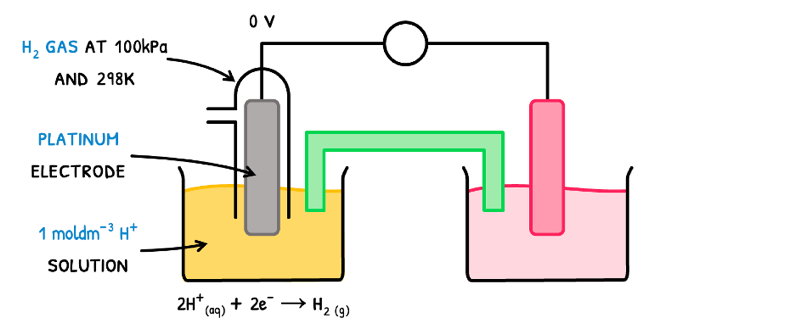
- A platinum electrode.
- This is surrounded by a container containing H2 gas.
- This set-up is submerged in a 1.0 mol dm-3 H+ solution
- All conditions are at standard temperature and pressure (298 K and 100 kPa).
This half-cell is connected to another half-cell of itself. Since both reactions are equally spontaneous, neither occurs and the voltage difference between the electrodes is 0V.
Thus, when the SHE is connected to a half-cell of a species in the electrochemical series, the voltage difference between the two electrodes is the standard electrode potential.