IB Chemistry Sub-topic R3.1 Notes
This page contains our IB Chemistry notes for sub-topic R3.1. By reading each one of these notes, you will fully cover the content for IB Chemistry 'Proton transfer'.
Loading progress...
Proton transfer
Topic R3.1 focuses on proton transfer reactions, the most common of which are reactions involving acids and bases. However, their properties are rather complex and require an in-depth look to understand the full process. Acids and bases can be described by three theories:
- Ionic theory - involves the formation of protons.
- Brønsted-Lowry theory - involves the transfer of protons.
- Lewis theory - involves the transfer of electrons, so covered in Topic R3.4.
Ionic Theory
Let's start with ionic theory, which is very simplistic. It has two key principles:
- Acids dissolve in water to produce H+ at a concentration greater than 1.0 x 10⁻⁷ mol dm-3.
- Bases dissolve in water and can neutralize acids.
Brønsted-Lowry Theory
Brønsted-Lowry theory is more complicated. This also has two principles:
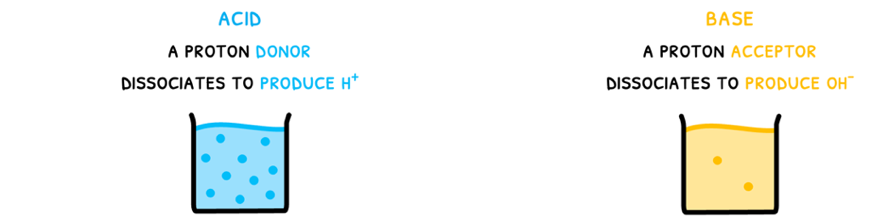
- Acids dissociate to produce H+, which is subsequently donated to another molecule.
- Bases dissociate to produce OH-, and subsequently accepts a proton.
Conjugate Acids and Bases
The species formed from these reactions are:
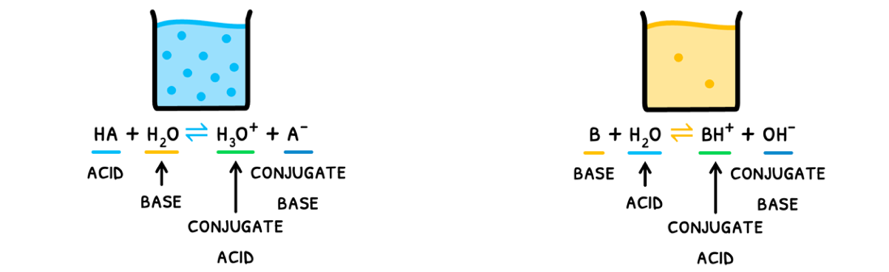
- Conjugate base - the ion formed by an acid donating a proton. As a result, this ion can now accept a proton and is thus a base.
- Conjugate acid - the ion formed by a base accepting a proton. As a result, this ion can now donate a proton and is thus an acid.
As you can see, a conjugate acid-base pair thus differs by one proton.
However, some species can act as both both Brønsted-Lowry acids and bases, which are called amphiprotic species. An example is HCO3-:
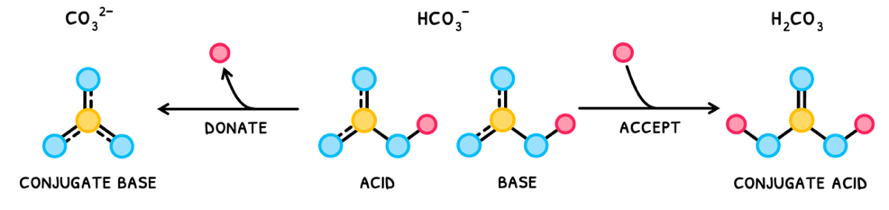
- It can donate a proton to become CO32-.
- It can accept a proton to become H2CO3.
tibertutor.com
Great Work!
You have now covered all of our sub-topic R3.1 notes, covering "Proton transfer" for IB chemistry.
Now that you have completed these IB chemistry sub-topic R3.1 notes, covering "Proton transfer", dive into our sub-topic R3.1 flashcards for the IB chemistry course.
IB chemistry sub-topic R3.1 flashcards
Explored IB Chemistry?
Get stuck into one of our other subjects!
Join 85,000 students, across 130+ countries, in 500+ IB schools. That's half of the IB science graduates worldwide.
Start a 7d free trial