IB Biology Sub-topic D2.1 Notes
This page contains our IB Biology notes for sub-topic D2.1. By reading each one of these notes, you will fully cover the content for IB Biology 'Cell cycle'.
Loading progress...
Cell proliferation
Now that you know nearly everything these is to know about cells, you need to understand how cells grow and divide, called cell proliferation. This is an important process in tissues for:
- Tissue growth
- Cell replacement
- Tissue repair
In order to achieve this, cell undergo:
- Stem cells specific to the tissue undergo mitosis to produce two identical daughter cells.
- One of these remains a stem cell and the other differentiates into the specific cell type needed.
- This thus adds new cells to tissue to increase tissue size, replacing lost cells, or both to replace injured/dead tissue.
You are expected to remember three examples of cell proliferation:
- In apical plant meristem, stem cells undergo this process to add new cells to the root or shoot. This is thus cell proliferation for growth.
- In early-stage embryos, stem cells undergo this process to develop and grow tissues and organs over time. This is thus also cell proliferation for growth.
- In the skin, the top layer of cells regularly sheds or gets cut and injured. Thus, stem cells undergo this process to replace lost or dead cells. This is thus cell proliferation for routine cell replacement and wound healing.
Cell cycle
Continuous cell proliferation is only possible if cells continuously divide. However, their division is only a small part of a repeating sequence of events cells pass through, called the cell cycle.
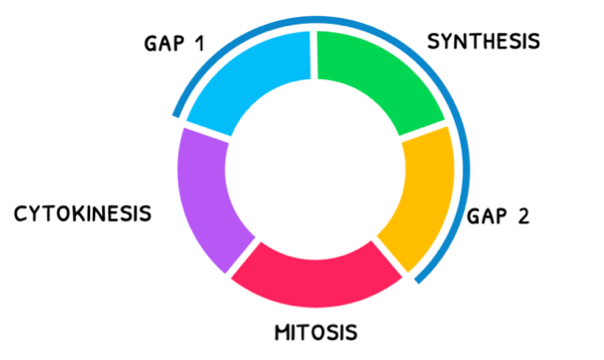
The cell cycle consists of three main stages:
- Mitosis – this is the stage during which replicated chromosomes are divided to produce two identical daughter nuclei, in preparation for cell division.
- Cytokinesis – this is the stage during which the cell divides in two to produce two identical daughter cells of the same size. Note that in cytokinesis during oogenesis and budding in yeast, this yields two daughter cells of different sizes.
- Interphase – this is the active stage during which the cell spends most of its life and prepares for division. It is composed of four phases:
- Gap 1 – this is the first growth stage of the cell right after mitosis, where proteins are synthesized, and organelles are duplicated to help the cell carry out its function. After Gap 1, the cell can enter either Gap 0 or Synthesis.
- Gap 0 – this is an additional temporary or permanent stage the cell sometimes enters, where the cell does not divide or prepare for division.
- Synthesis – this is the phase wherein the cell undergoes mass organelle and DNA replication to double its chromatin and organelle count.
- Gap 2 – this is the second growth stage of the cell to prepare for mitosis. During this phase, the cell performs a DNA damage check, grows larger, and synthesizes more protein.
tibertutor.com
Great Work!
You have now covered all of our sub-topic D2.1 notes, covering "Cell cycle" for IB biology.
Now that you have completed these IB biology sub-topic D2.1 notes, covering "Cell cycle", dive into our sub-topic D2.1 flashcards for the IB biology course.
IB biology sub-topic D2.1 flashcards
Explored IB Biology?
Get stuck into one of our other subjects!
Join 85,000 students, across 130+ countries, in 500+ IB schools. That's half of the IB science graduates worldwide.
Start a 7d free trial