IB Biology Sub-topic B2.2 Notes
This page contains our IB Biology notes for sub-topic B2.2. By reading each one of these notes, you will fully cover the content for IB Biology 'Further organelles'.
Loading progress...
Mitochondrial adaptations
In the HL syllabus, you need to know more detail about specific organelles, beginning with the mitochondria. Remember that the link reaction, Krebs cycle, and oxidative phosphorylation all occur in the mitochondria, for which is has certain adaptations:
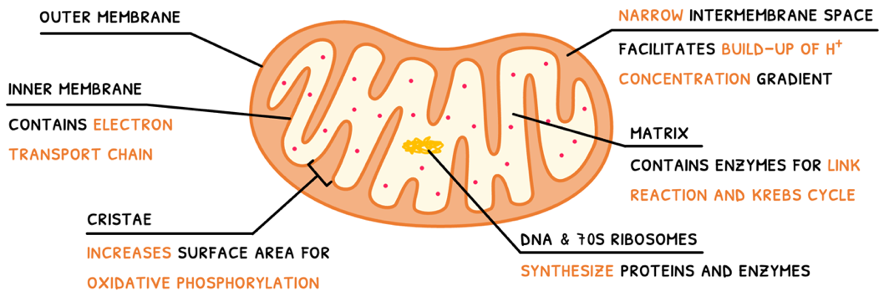
- Outer membrane - this separates the mitochondria from the rest of the cell.
- Inner membrane - this contains the electron transport chain and ATP synthase for oxidative phosphorylation.
- Cristae - folds of the inner membrane to increase the surface area for oxidative phosphorylation.
- Intermembrane space - the narrow space between the inner and outer membrane, which facilitates a rapid build-up of a H+ concentration gradient.
- Matrix - the mitochondria's cytoplasm, which contains the enzymes required for the link reaction and Krebs cycle.
- DNA & 70S ribosomes - the nucleoid and 70S ribosomes to synthesize its proteins and enzymes.
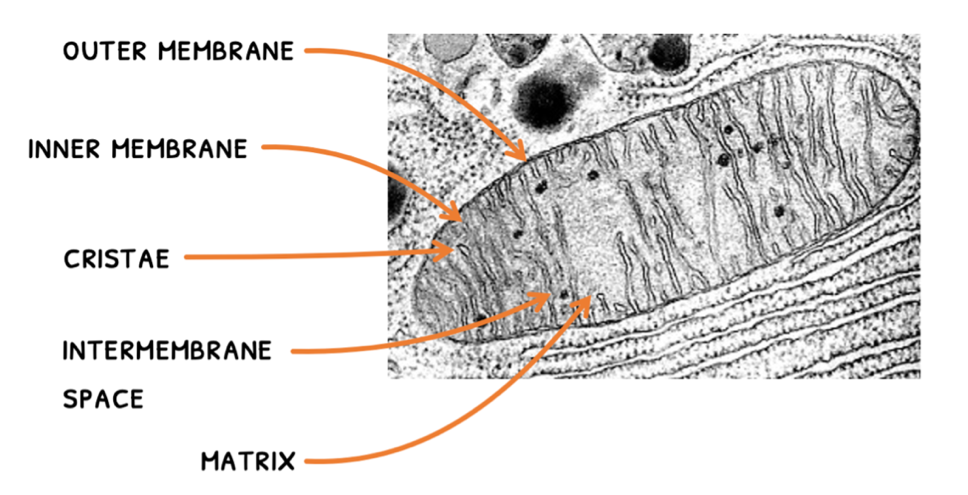
In recent years, electron tomography has been able to 3D visualize the mitochondria. Whilst a neat trick, you need to be able to label the same structures on a 2D electron micrograph:
Chloroplast adaptations
Next, you need to know about the mitochondria. Remember that the light-dependent reactions of photosynthesis all occur in the chloroplast, for which is has certain adaptations:
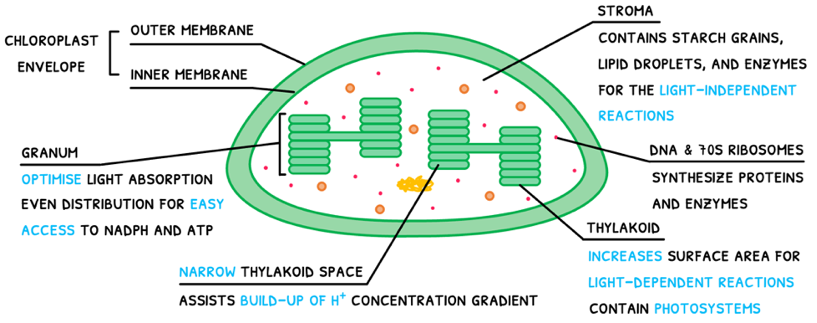
- Chloroplast envelope - composed of the inner and outer chloroplast membranes, this separates the chloroplast from the rest of the cell.
- Stroma - the chloroplast cytoplasm, which contains starch grains, lipid droplets and enzymes, all required for the light-independent reactions.
- Thylakoids - systems of internal membranes that increase the surface area for the light-dependent reactions.
- Thylakoid membrane - contains photosystems, the electron transport chain, and ATP synthase for the light-dependent reactions.
- Grana - towers of thylakoids adapted to optimize light absorption and evenly distributed throughout the stroma for easy access to NADPH and ATP.
- Thylakoid space - a narrow space that allows the quick build-up of the H+ concentration gradient.
- DNA and 70S ribosomes - used to synthesize proteins and enzymes.
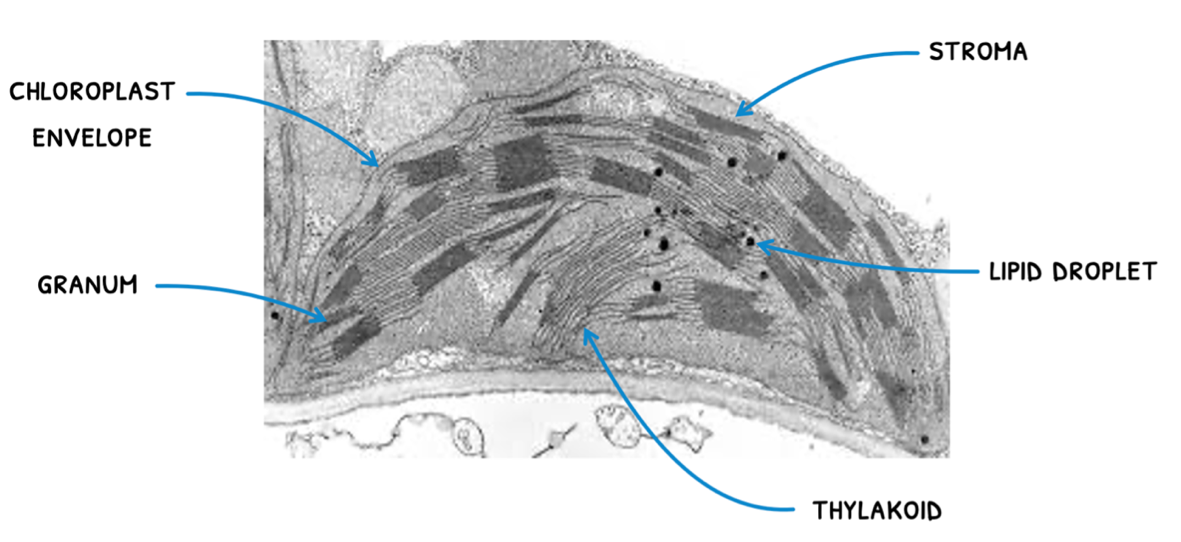
You must also be able to recognize these structures in an electron micrograph:
tibertutor.com
Great Work!
You have now covered all of our sub-topic B2.2 notes, covering "Further organelles" for IB biology.
Now that you have completed these IB biology sub-topic B2.2 notes, covering "Further organelles", dive into our sub-topic B2.2 flashcards for the IB biology course.
IB biology sub-topic B2.2 flashcards
Explored IB Biology?
Get stuck into one of our other subjects!
Join 85,000 students, across 130+ countries, in 500+ IB schools. That's half of the IB science graduates worldwide.
Start a 7d free trial