IB Biology Sub-topic C2.2 Notes
Action potentials
In the SL syllabus, you learned about neurons and the basics of nerve impulses. However, you need to know how a nerve impulse is generated within a neuron and how it propagates along it.
This is called the formation of an action potential, whereby the resting membrane potential of an axon is lost. It is officially defined as the depolarization and repolarization of a neuron due to the movement of ions. Let's explore these terms:
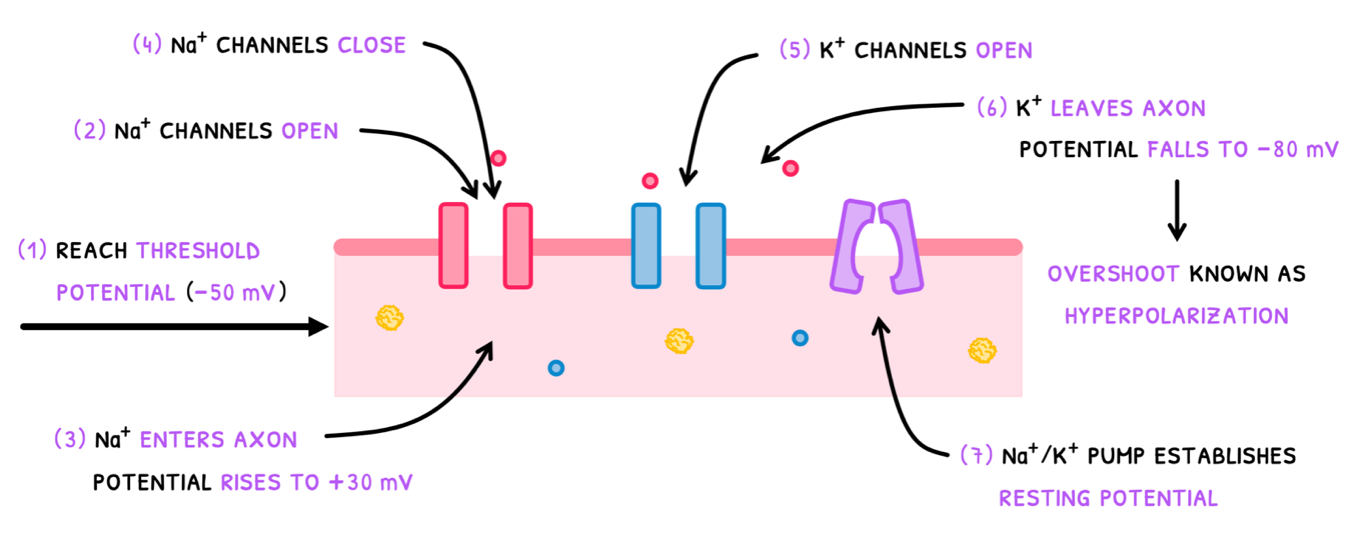
- A positive impulse from a prior portion of the neuron elevates the potential from -70 mV to -50mV, the threshold potential.
- This causes depolarization of the axon, during which voltage-gated Na+ channels are opened to allow the facilitated diffusion of Na+ into the axon.
- This causes the inside of the axon to become more positive, so the potential rises to +30 mV.
- Next, repolarization occurs. First, the Na+ channels close and prevent further entry of sodium.
- Then, voltage-gated K+ channels open to allow the facilitated diffusion of out of the axon.
- This causes the inside of the axon to become more negative, so the membrane potential falls to -80 mV. This overshoot past resting potential is known as hyperpolarization.
- To re-establish resting membrane potential of -70 mV, the Na+/K+ pump exchanges ions back to their original levels.
Local currents
Now that you understand what an action potential is, it is important to understand how it initiates and propagates. This occurs via one of two methods: local currents and synaptic transmission.
Let's start with local currents. These are positive waves of charge that help adjacent axon parts reach the threshold potential. There are a few elements contributing to this:
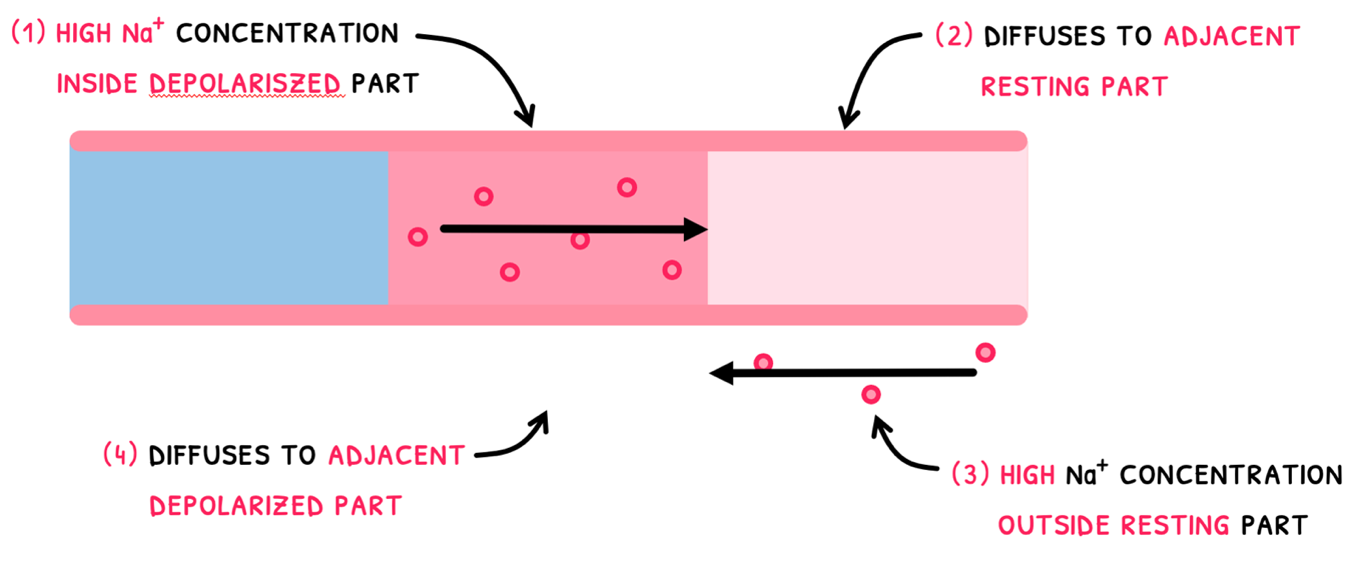
- Inside the depolarized area, the Na+ concentration is high.
- Since the next area has a low Na+ concentration, some of it diffuses there, raising its potential.
- Meanwhile, outside the adjacent part there is a high Na+ concentration since it has not depolarized yet.
- Outside the depolarized part, the Na+ concentration is low and thus the ions diffuse to there.
These two movements cause potential of the adjacent part to increase to the threshold potential and initiate the action potential.
However, the action potential does not occur in the previous part of the axon. This is because repolarization of that part means that further action potentials cannot occur for a short period of time, known as the refractory period. This ensures unidirectionality since an action potential must terminate at the opposite end to which it originates.