IB Biology Sub-topic A2.2 Notes
Cell theory
Cells are vital to the existence of living organisms. They were first viewed by Robert Hooke in bottle cork under a microscope. After years of observing cells, several scientists eventually developed the main tenets describing cells, called the cell theory. These three tenets are:
- Cells are the smallest unit of life.
- All living organisms are made up of cells.
- All cells come from pre-existing cells.
Although there are more tenets that have been added over the years, you are not expected to recite these on your IB exams. However, it is widely regarded that cells should only have one nucleus or not grow beyond a particular size. There are three exceptions to this you are expected to know: skeletal muscle, aseptate fungi, and giant algae.
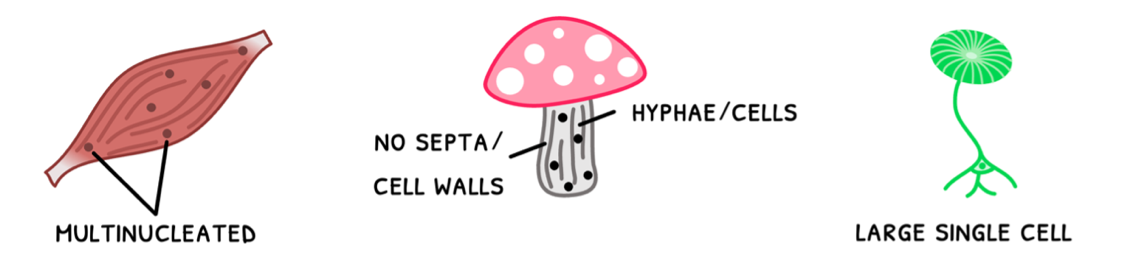
- Skeletal muscle fiber cells are incredibly long. As a result, they need multiple nuclei per cell too maintain proper function in the whole cell, termed multi-nucleated.
- Fungi have thin fibrous cells called hyphae. Each hypha is divided by a cell wall, called a septum. Aseptate fungi do not contain septae, meaning they are also multi-nucleated.
- Giant alga is an incredibly large single celled organism, ranging from 0.5 to 10 cm in length.
Now that you know about the basics of the cells, it is important to note that the organisms that these cells form are divided into two types: unicellular organisms, composed of one cell of ≈10μm, and multicellular organisms, composed of more than one cell of ≈100μm. These each differ in structure, so let’s review this now.
Prokaryotes
Unicellular organisms are referred to as prokaryotes, and their structure is succinctly described as a simple cell structure without compartmentalization. The common external components of prokaryotic cells that you are expected to remember are:
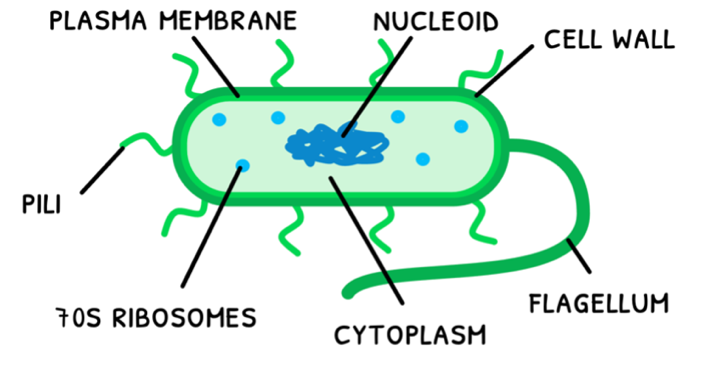
- The cell wall – this is a barrier composed of peptidoglycan that acts as a scaffold and maintains the cell’s shape. It is also the point of attachment of the pili and flagellum.
- The pili – these are hair-like structures that allow the prokaryote to interact with its external environment via adhesion and conjugation.
- The flagellum – this is a corkscrew-shaped tail-like structure that rotates to propel the prokaryote forward.
- The plasma membrane – this is a thin double layer of phospholipid, termed the phospholipid bilayer, that controls the transport of materials in and out of the cell.
The common internal components of prokaryotic cells that you are expected to remember are:
- The cytoplasm – this the internal fluid-like matrix where most cellular processes occur, and all organelles are located.
- The nucleoid – this is a naked circular loop of DNA. The term naked describes how this DNA is not associated with proteins.
- 70S ribosomes – these are small granular structures involved in many cellular processes, but primarily used to synthesize proteins. In prokaryotes, 70S describes their molecular size.