IB Biology Sub-topic C2.2 Notes
Neurons
In Topic C2.2, the focus is on the nervous system. Although there are many cells that compose the nervous system, you only need to focus on one type: neurons. These are primarily responsible for transmitting electrical impulses and divided into two types:
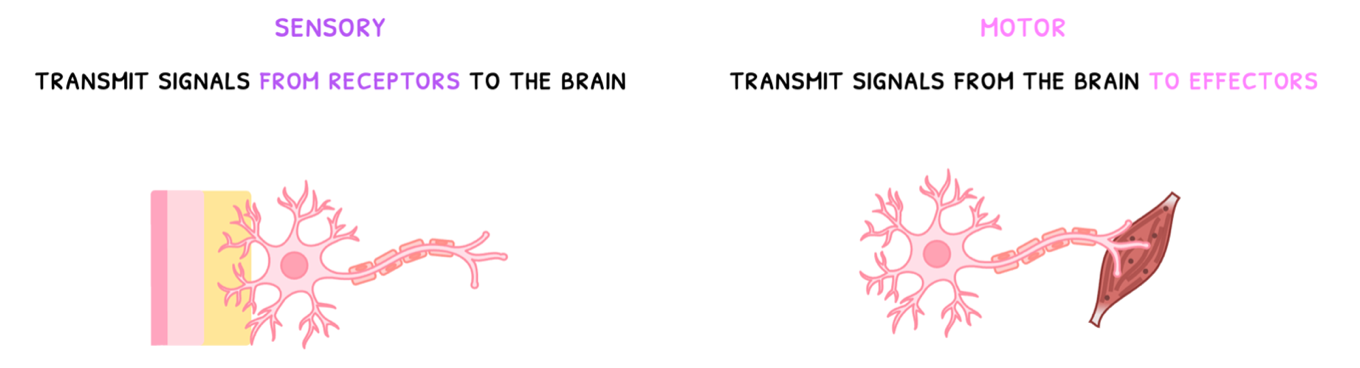
- Sensory neurons - these transmit signals from receptors to the brain.
- Motor neurons - these transmit signals from the brain to effectors (muscles).
You are expected to know the structure of a neuron well. It is composed of:
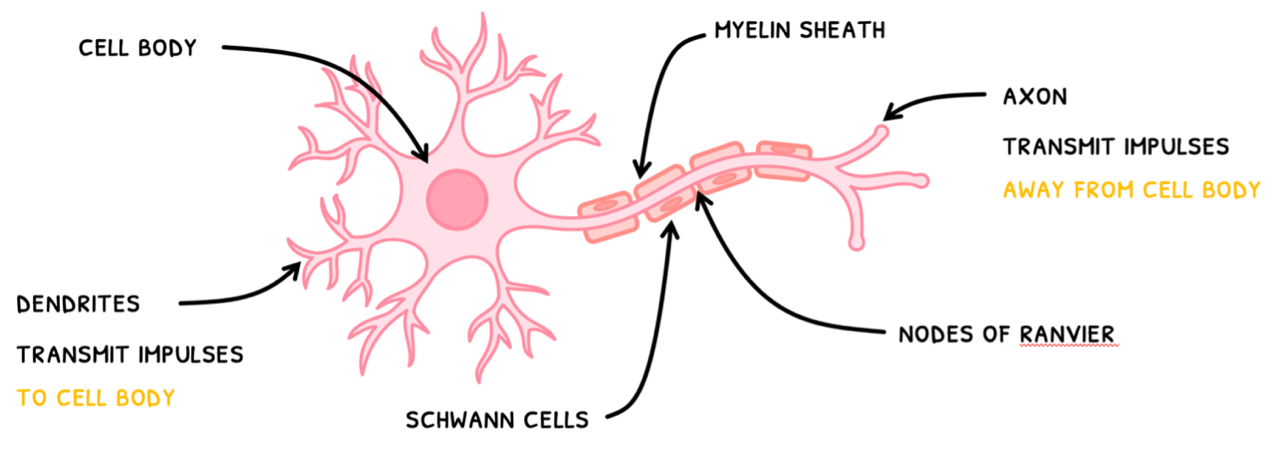
- Dendrites - short branched fibers that connect to other neurons and receive their impulses.
- Cell body (soma) - contains a cytoplasm and nucleus and receive all impulses from the dendrites.
- Axon - a long cylindrical 1 μm fiber that transmits the impulses away from the soma to other structures.
Resting potential
This makes neurons extremely adapted to their function, but their axons can be incredibly long. Therefore, it is important to understand how the nerve impulse is generated and propagated.
In IB biology, you use the term action potential instead of nerve impulse. This action potential takes the neuron away from its resting state, called the resting potential.
At resting potential, the inside of an axon is said to be more negative compared to the outside. Numerically, we say it has a resting potential of -70 mV. This voltage is due to three main factors:
- The Na+/K+ pump keeps pumping 3 Na+ out and 2 K+ in, making the outside more positive.
- The axonal membrane is more permeable to K+, allowing it to leave the make the outside more positive.
- Negative proteins inside of the axon make the inside more negative.