IB Biology Sub-topic B2.3 Notes
Stem cells
You previously learned about the basic components of eukaryotic and prokaryotic cells. In prokaryotes, this is all there is to the organism. However, in eukaryotes are larger multicellular organisms, requiring many different types of specialized cells. These all originate from a zygote, which undergoes mitosis into unspecialized cells. These are called stem cells, which are capable of dividing endlessly and specializing along different pathways via a process called differentiation.
The process of differentiation in the early-stage embryo is directed by external chemical called morphogens. These function as follows:
- Source cells secrete morphogens at different parts of the embryo as a positional guide.
- This will form a side with a low morphogen concentration and another side with a high morphogen concentration, forming a gradient.
- The morphogen then act on nearby cells to generate a change in gene expression, causing differentiation.
- Thus, cells on the high concentration side differentiate into the target tissue, whereas cells on the low concentration side do not.
This is thus a gradient of gene expression, will results in the formation of tissues in specific locations. As these differentiate and grow as according to the gradients, they end up forming organs, and then the whole body.
Thus, this process is necessary in embryonic development, growth into adulthood, and continual cell renewal throughout life.
There are four different types of stem cells you need to know about: totipotent, pluripotent, multipotent, and unipotent stem cells.
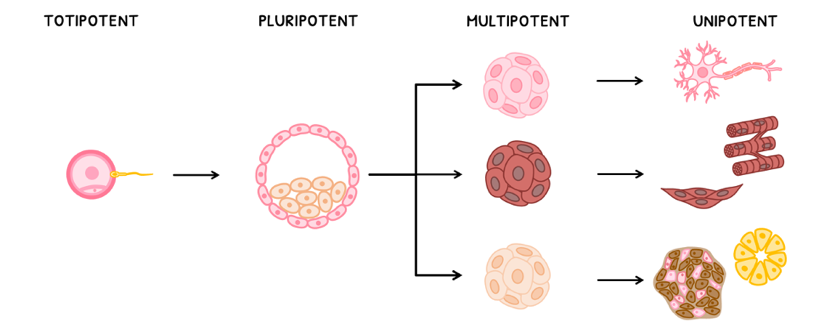
- Totipotent - embryonic stem cell type that can develop into any type of cell in the body.
- Pluripotent - embryonic stem cell that can develop into many types of cells in the body.
- Multipotent - non-embryonic stem cell that can develop into several types of cells in the body.
- Unipotent - non-embryonic stem cell that can develop into one type of cell in the body.
Sources of stem cells
Due to their capacity to differentiate into different cell types, stem cells are often used in therapeutic settings. However, before they are used, they need to be sourced. It is generally the trend that the less developed the source, the more undifferentiated the stem cells are and the more therapeutic use there is. However, the less developed the source, the less biomarkers it has, and the less compatible it is. There are three sources you need to know about: embryos, the umbilical cord, and adults.

- Embryonic - these cells are contained within embryos. As a result, they are usually pluripotent but not fully compatible with patients.
- Cord blood - these cells are found in umbilical cord blood. As a result, they are multipotent and fully compatible with patients.
- Adult - these cells are found in adults. All of these are compatible, but most adult cells are unipotent, with some being multipotent.
You are expected to remember two types of stem cell niches in adults, including bone marrow and hair follicles.
- Bone marrow stem cells are located in the bone marrow. There, they divide and differentiate into red blood cells, white blood cells, and platelets, replenishing their numbers as they die cyclically every few weeks.
- Hair follicle stem cells are located in the bulge of a hair follicle. There, they divide and differentiate into hair follicle cells, sebaceous gland cells, and epidermal cells, replacing hair and skin as they are lost.