IB Biology Sub-topic B2.1 Notes
Membrane fluidity
In the HL syllabus, you are expected to understand more detail about membranes and membrane models. This begins with membrane fluidity, which changes depending on the type of lipid involved in the bilayer:
- Unsaturated fatty acids have a bend in their chain, resulting in a lower density and melting point. As a result, it makes membranes more fluid and flexible at body temperature.
- Saturated fatty acids have straight chains, resulting in a higher density and melting point. As a result, it makes membranes more rigid and strong at body temperature.
- Cholesterol sits inside of the bilayer and interacts with the phosphate head of one phospholipid and the lipid tail of another phospholipid binding them together. It thus acts as a modulator of membrane fluidity by stabilizing membranes at higher temperatures and preventing stiffening at lower temperatures.
As a result, plasma membrane need to strike a balance between fluidity to coordinate important processes and rigidity to maintain structural integrity. The degree of composition is thus dependent on the temperature of the organism's habitat:
- Cold habitats - have a higher amount of unsaturated fatty acids to maintain fluidity at low temperatures.
- Normal habitats - have an even amount of saturated and unsaturated fatty acids.
- Warm habitats - have a higher amount of saturated fatty acids to maintain rigidity at high temperatures.
Vesicular transport
This fluidity of the membrane allows cells to form variable shapes and form barriers together. However, in the context of transport, it allows the movement of large materials, or materials in bulk, into and out of the cell by using vesicles. Vesicles are spheres of phospholipid bilayer, as shown below, formed when the pinching off the plasma membrane. This allows for two modes of transportation: endocytosis and exocytosis.

- Endocytosis is the transport of large materials, or materials in bulk, into the cell. The process for this is:
- Materials come near the plasma membrane.
- Then, plasma membrane invaginates to engulf the materials.
- Once engulfed, the plasma membrane pinches off to form a vesicle, which moves through the cytoplasm to its end destination.
- Exocytosis is the transport of large materials, or materials in bulk, out of the cell. The process for this is:
- The Golgi bodies envelop material in a vesicle.
- This moves to the plasma membrane and fuses with it, releasing the contents.
- Afterwards, the membrane flattens to its original shape.
Gated ion channels
Now that you know about membrane fluidity and vesicular transport, you are expected to know more detail about specific transport methods. This begins with gated ion channels, including the potassium pump and nicotinic acetylcholine receptors.
Let's start with the potassium pump, which is a voltage-gated ion channels found in neurons. This means that its opening and closing is regulated by the membrane potentials. This process occurs as follows:
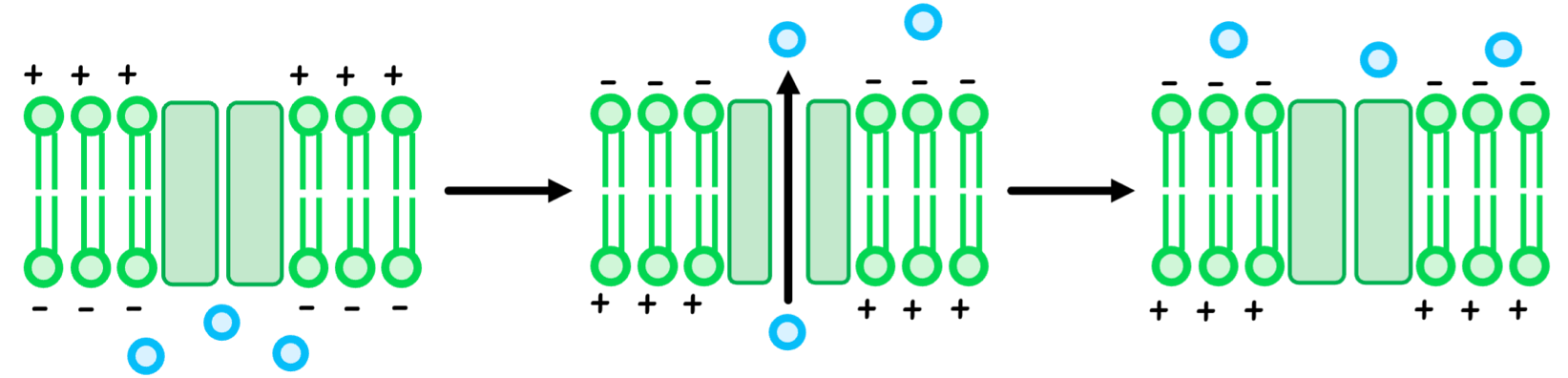
- When the neuron is at rest, its internal charge is negative relative to the outside, keeping the potassium channel closed.
- When the neuron fires a signal, its internal charge becomes positive relative to the outside, opening the potassium channel.
- For a moment, potassium ions undergo facilitated diffusion to leave the neuron.
- When the internal charge quickly drops again to become negative, the potassium channel closes again.