IB Biology Sub-topic B2.1 Notes
Hydrophilic and hydrophobic molecules
You have previously learned that all cells contain a plasma membrane, which controls the transport of materials in and out of the cell. The structure as we know it today was formed from a series of models. However, before this is covered, it is important to understand a few key concepts: hydrophobic and hydrophilic molecules.
- Hydrophobic molecules are repelled by water and so only bond with other hydrophobic molecules. Lipids (fats) are an example of a hydrophobic molecule.
- Hydrophilic molecules are attracted to water and so only bond with water or other hydrophilic molecules. Proteins are an example of a hydrophilic molecule.
- Amphipathic molecules are partly hydrophobic and partly hydrophilic, allowing them to bond with water/hydrophobic molecules and hydrophobic molecules at the same time.
Lipid bilayers
An example of an amphipathic molecule is a phospholipid, a type of fat that is a central component of the plasma membrane. Remember that phospholipids have a hydrophilic phosphate head and two hydrophobic lipid tails. As a result, lipids in the plasma membrane form a continuous sheet-like bilayer in water-based environments:
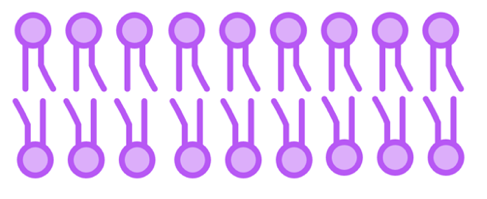
- Hydrophilic phosphate heads face outwards towards water.
- Hydrophobic lipid tails face inwards towards each other to stabilize the bilayer.
- This structure means that the membrane core has a low permeability to large molecules and hydrophilic particles, including ions and polar molecules.
Overall, having a lipid bilayer is thus an effective barrier between aqueous solutions and capable of controlling transport in and out of hte cell.
Fluid mosaic model
However, the membrane has more components than the phospholipid bilayer. The model for this is called the fluid mosaic model, whose main components are:
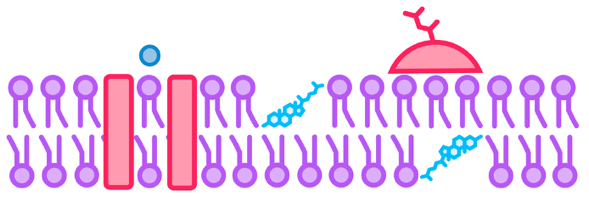
- The membrane is a lipid bilayer composed of phospholipids and cholesterol, with the hydrophilic phosphate heads facing outward and the hydrophobic lipid tails facing inward.
- The phospholipids are fluid and able to flow freely throughout the membrane. Cholesterol impedes phospholipid flow, making the membrane stiffer and reducing its permeability to
- Proteins do not form an outer layer, but instead are found on the outside of the phosphate heads, termed peripheral proteins, or pass through one or both lipid layers, termed integral proteins.