IB Biology Sub-topic A3.2 Notes
Classification
You previously learned about species and the binomial naming system. However, the binomial naming system is only a subpart of a whole system of organism classification. Taxonomy is the study of classifying organisms, which has resulted in this classification system.
It groups organisms with shared ancestors together in tiers called taxa, of which there are eight main ones you need to know:
- Domain
- Kingdom
- Phylum
- Class
- Order
- Family
- Genus
- Species
The sequence of taxa can easily be remembered with the mnemonic Dumb King Phillip Came Over For Good Spaghetti.
As you go down the taxa, they become more specific. Each subsequent taxa will contain fewer species with an increasing number of similar traits.
Cladistics
However, since evolution is gradual, having fixed ranks means that the patterns of divergence do not always correspond to the classification. An alternative approach to this is cladistics. In cladistics, groups of organisms with a common ancestor are termed clades. They are thus like taxa, but can be applied for any group of organisms, small or large.
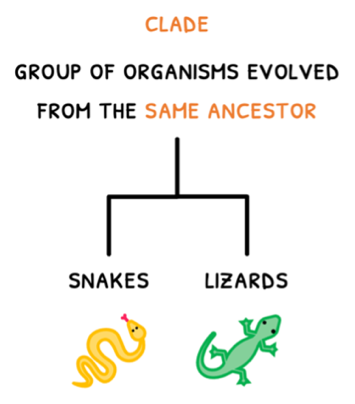
Cladistics was historically based off morphology, and thus an example of artificial classification, but is now based off amino acid sequence, making it highly accurate.
In cladistics, visual diagrams can be made to present the relationship between different organisms and where they had a common ancestor. These visual diagrams are known as cladograms.
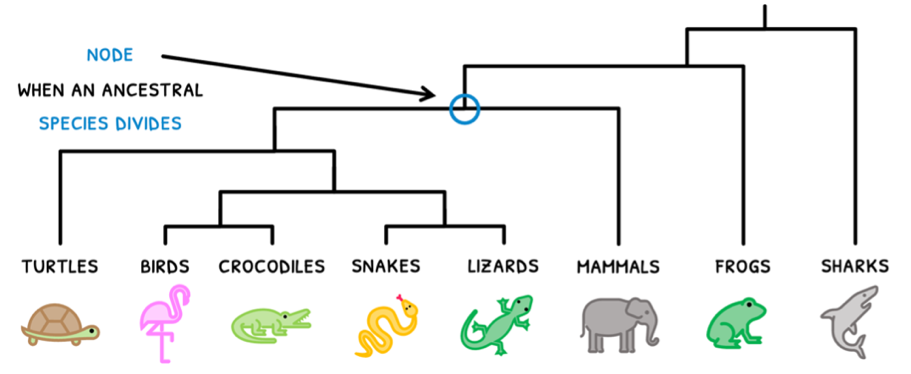
In a cladogram are branching points, termed nodes, which signify when an ancestral species divides to form two or more species. Cladograms display the most likely hypothetical path of evolution, based on the smallest number of changes possible, known as the principle of parsimony.