IB Biology Sub-topic D3.1 Notes
This page contains our IB Biology notes for sub-topic D3.1. By reading each one of these notes, you will fully cover the content for IB Biology 'Reproduction'.
Loading progress...
Reproduction
In Topic D3.1, you learn about reproduction. Remember that this is the production of offspring by parents and that this can occur in two ways:
- Asexual reproduction - a parent organism independently produces genetically identical offspring. This can only occur when the parent is adapted to the environment, or the offspring will not survive.
- Sexual reproduction - two parent organisms produces gametes and bring them together during fertilization. This produces offspring with genetic variation as they need adaptation to a changing environment.
Within sexual reproduction, males and females have different reproductive strategies:
- Males are involved in physical or sperm competition with one another to have the chance to reproduce with a female.
- Females are thus in a position of power and strategize to obtain resources from males or the best male genes for their offspring.
Reproductive anatomy
Now that you know the basics of fertilization, you are expected to identify and outline the function of the reproductive structures in males and females.
Starting with males, their reproductive structures include:
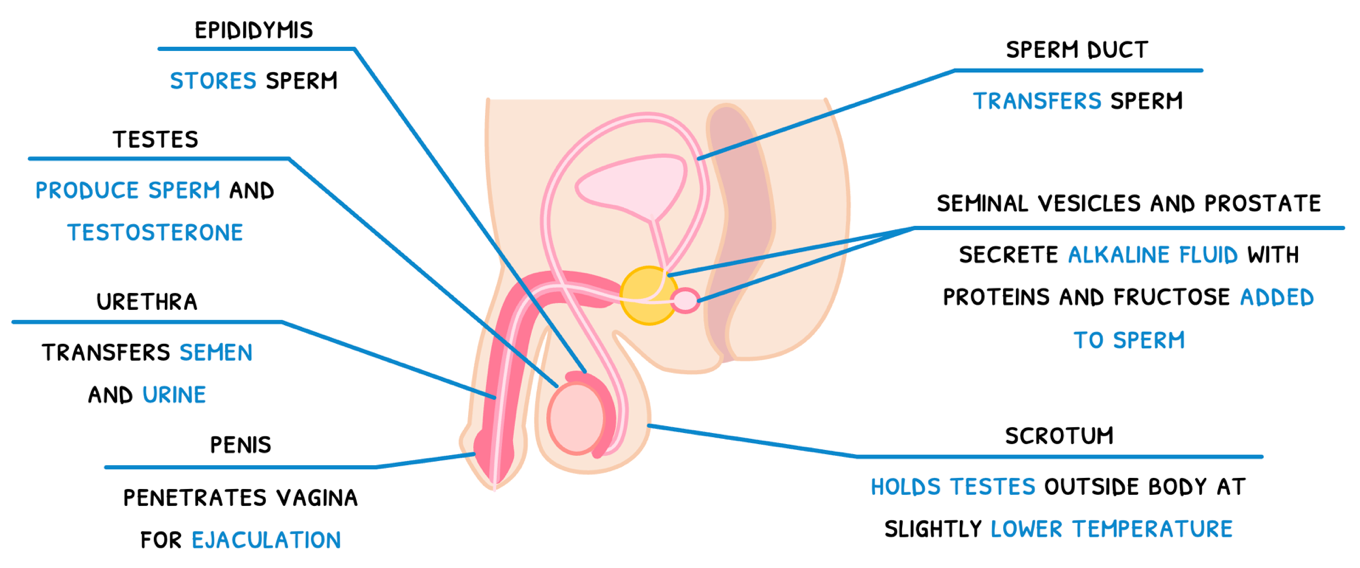
- The testes - egg-shaped structures that produce sperm and testosterone.
- The epididymis - a structure located atop each teste, which stores sperm.
- The scrotum - a sac that holds the testes outside the body, at a temperature slightly lower than core body temperature.
- The sperm duct - a tube which transfers sperm.
- The seminal vesicle and prostate gland - structures which secrete an alkaline fluid containing proteins and fructose which are added to sperm to make semen.
- The urethra - a tube that transfers semen and urine.
- The penis - a muscular structure that penetrates the vagina for ejaculation near cervix.
The female reproductive system contains:
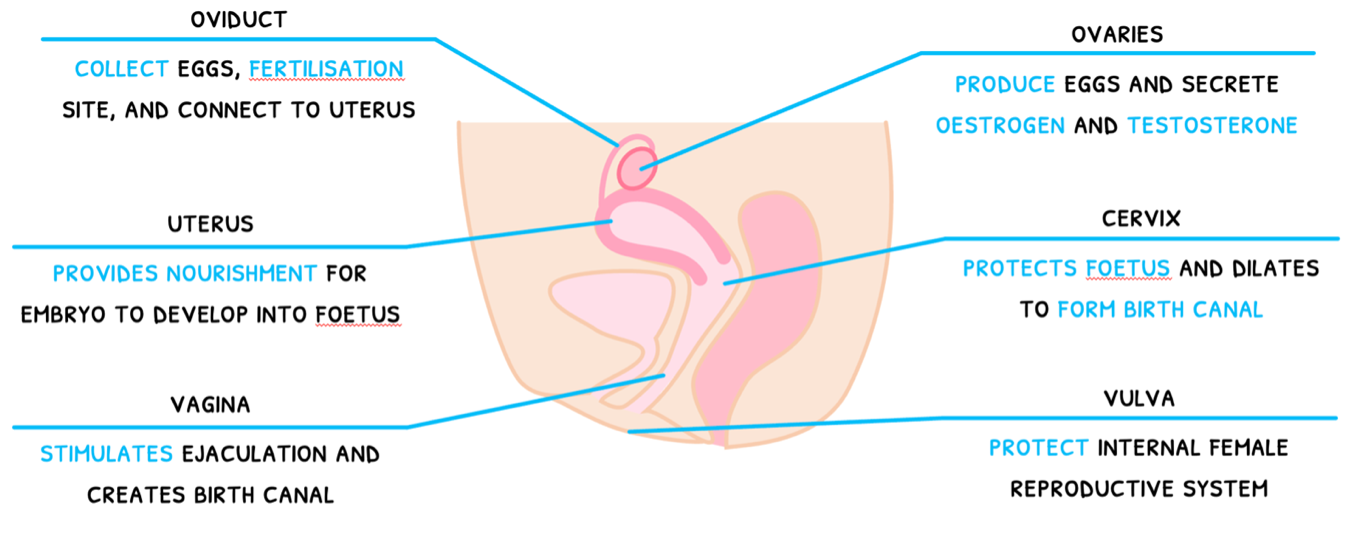
- The ovaries - egg shaped structures that produce eggs and secrete oestrogen, and progesterone.
- The oviducts - tubes which collect eggs, provide a fertilisation site and transfer the embryo to the uterus.
- The uterus - a structure which provides nutrients and hormones for the embryo to develop to form a foetus. The lining of the uterus is known as the endometrium.
- The cervix - a structure which protects the foetus and dilates to create the birth canal.
- The vagina - a structure which stimulates ejaculation and creates the birth canal.
- The vulva - structures which protect the internal female reproductive system.
tibertutor.com
Great Work!
You have now covered all of our sub-topic D3.1 notes, covering "Reproduction" for IB biology.
Now that you have completed these IB biology sub-topic D3.1 notes, covering "Reproduction", dive into our sub-topic D3.1 flashcards for the IB biology course.
IB biology sub-topic D3.1 flashcards
Explored IB Biology?
Get stuck into one of our other subjects!
Join 85,000 students, across 130+ countries, in 500+ IB schools. That's half of the IB science graduates worldwide.
Start a 7d free trial