IB Biology Sub-topic C3.2 Notes
This page contains our IB Biology notes for sub-topic C3.2. By reading each one of these notes, you will fully cover the content for IB Biology 'Defence against infectious disease'.
Loading progress...
Immune system
Whilst you will learn about normal body function and how it fails during conditions, it is also important to understand how the body handles infectious disease. Organisms or viruses that cause infectious disease are called pathogens. The is the job of the immune system is to prevent pathogens from causing a disease, which is divided into:
- Primary defense system – structures that aim to prevent pathogen entry.
- Secondary defense system – structures that aim to destroy pathogens that have bypassed the primary defense system.
Primary defense system
Let’s start with the primary defense system. The structures that contribute to the prevention of pathogen entry include:
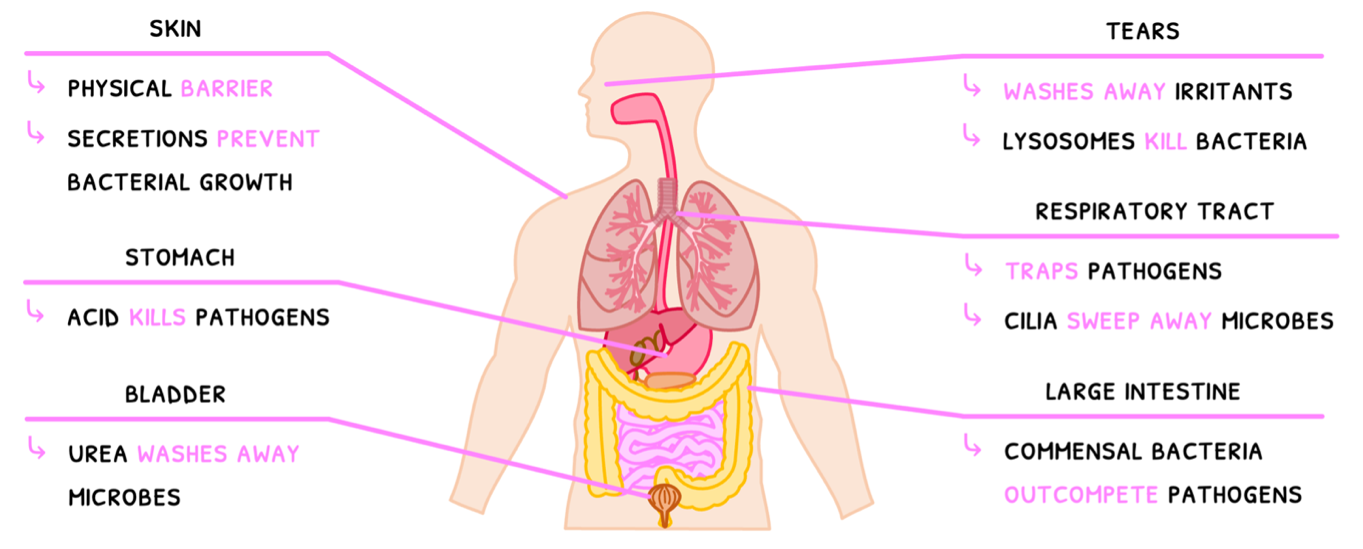
- The skin is a thick outer layer that forms a physical barrier against pathogen entry. It contains sebaceous glands that secrete lactic acid and fatty acids to prevent bacterial growth.
- Tears wash away irritants and microbes and contain lysosomes to kill bacteria.
- The respiratory tract and nose have a moist mucous membrane which traps pathogens and contains lysosomes. The membrane also contains cilia, which are hair-like extensions on cells that move mucus out of the tract.
- The stomach contains hydrochloric acid to kill pathogens.
- The large intestine contains native bacteria, called commensal bacteria, that outcompete pathogenic bacteria.
- The bladder contains urea and washes away microbes trying to enter the urethra.
Clotting
However, these structures are not flawless. For example, the skin can be cut or tear, requiring a set of reactions to seal this point of entry. This is facilitated by a set of chemical reactions that result in the formation of a clot.
- A cut or tear to the skin typically damages blood vessels, exposing collagen fibers.
- The collagen fibers communicate damage, recruiting platelets within the blood.
- The platelets then release chemicals, known as clotting factors, to initiate the clotting cascade.
- The clotting factors also recruit further platelets to the tear to form an emergency barrier and prevent further blood loss.
- You do not need to know all the chemicals involved in the clotting cascade. However, you need to know that it occurs while more platelets are being recruited. At the end of the cascade, a few key reactions occur.
- Thromboplastin becomes activated, which catalyze the conversion of prothrombin into thrombin.
- Thrombin then converts inactive soluble fibrinogen into its active and insoluble form, known as fibrin.
- Fibrin is a filamentous protein, and its insolubility means that it sticks to the platelets and forms a mesh over the tear, forming a clot.
- This clot further prevents blood loss and dries to form a scab, preventing pathogen entry.
tibertutor.com
Great Work!
You have now covered all of our sub-topic C3.2 notes, covering "Defence against infectious disease" for IB biology.
Now that you have completed these IB biology sub-topic C3.2 notes, covering "Defence against infectious disease", dive into our sub-topic C3.2 flashcards for the IB biology course.
IB biology sub-topic C3.2 flashcards
Explored IB Biology?
Get stuck into one of our other subjects!
Join 85,000 students, across 130+ countries, in 500+ IB schools. That's half of the IB science graduates worldwide.
Start a 7d free trial