IB Biology Sub-topic D3.3 Notes
Homeostasis
The last component of Topic 3, this subtopic focuses on how the body communicates between organs via hormones, maintains itself via homeostasis, and the key components involved in reproduction.
Homeostasis should be familiar as a core function of life. It is defined as the ability to maintain a constant internal environment, and this can take many forms.
In this topic, you need to learn about the homeostasis of:
- Glucose concentration - via insulin and glucagon.
- Thermoregulation - via thyroxine.
Blood glucose regulation
Let's start with glucose concentration, controlled by the pancreas. Remember that it secretes digestive enzymes during digestion. This is part of its exocrine function (secretion into ducts), performed by duct cells. However, it also has an endocrine function (secretion into blood), performed by Islets of Langerhans. These primarily contain:
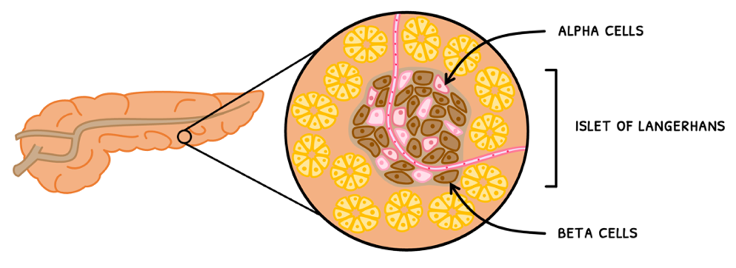
- Alpha cells - these secrete glucagon into blood.
- Beta cells - these secrete insulin into blood.
The pancreas thus releases one of these hormones when blood glucose concentration is imbalanced. When blood glucose concentration is high:
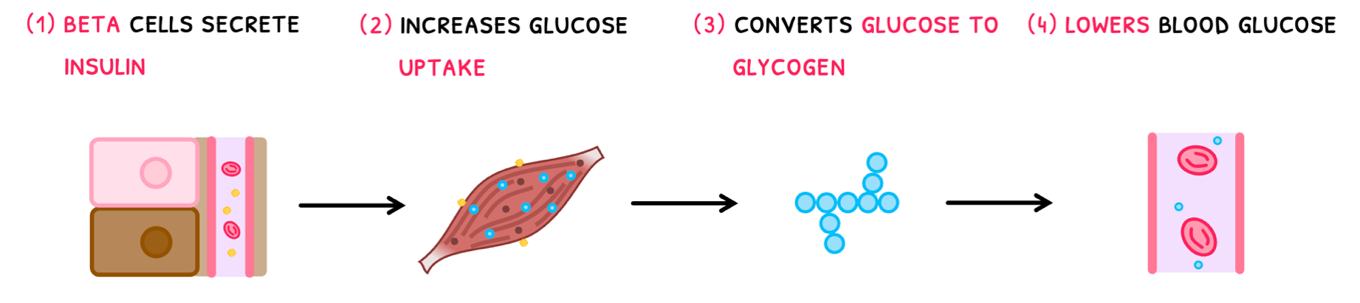
- Beta cells secrete insulin.
- This binds to insulin receptors in skeletal muscle and liver cells, stimulating an increase in glucose uptake.
- These sites convert the glucose to glycogen for storage.
- As a result, blood glucose concentration decreases.
When blood glucose concentration is low:
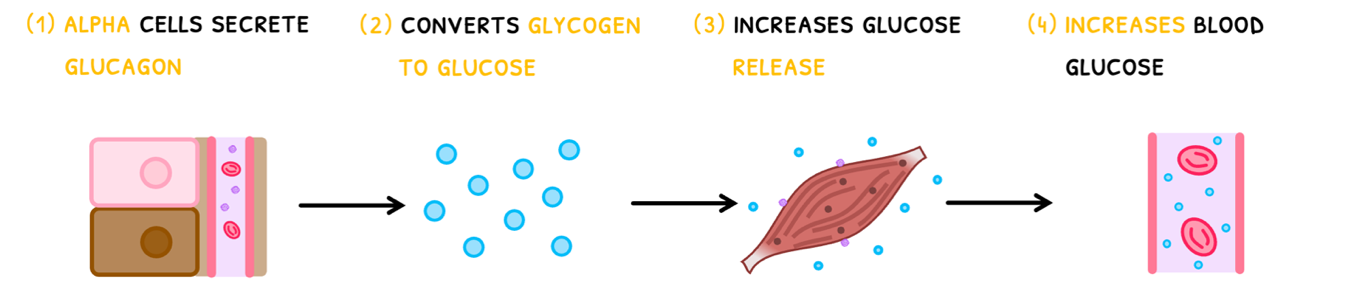
- Alpha cells secrete glucagon.
- It converts glycogen to glucose, for metabolism.
- It then stimulates skeletal muscle and liver cells to release glucose into the blood.
- As a result, blood glucose concentration rises.
You can remember which hormone does what with the phrase: "When all the glucose has gone, we need glucagon."
Diabetes
However, this feedback mechanism can fail, causing serious consequences. Failure of glucose regulation can lead to a condition known as Diabetes Mellitus, characterized by a consistently elevated blood glucose. This often leads to downstream symptoms, such as damage to the eyes, kidneys and feet.