IB Biology Sub-topic B3.3 Notes
Locomotion
So far you have learned about the transport and respiratory systems of organisms for them to live. Next, you need to know about their locomotion (movement), which begins with understanding the two types of species in this context:
- Sessile species - species that are fixed in one place. As a result, they respond to their environment by changing their growth or development. An example is the phototropism of plants.
- Motile species - species that are able to move around. As a result, they respond to their environment by changing their position. An example is the movement of crocodiles into the light to raise their body temperature.
Most sessile species evolved before muscles developed and therefore do not contain muscle. However, many organisms on the plant do contain muscle, and you need to know more detail about how muscles and related structures contribute to the movement of motile species.
However, movement is still very important as it is required to forage for food, escape from danger, search for a mate, and migrate at the least. Examples for each are expected but should be easy to mention from experience (a duck will perform all four).
Sarcomeres
Each myofibril is composed of many end-to-end units called sarcomeres. These are defined as the smallest functional unit of skeletal muscle. You are expected to know its structure in detail. Each sarcomere is composed of:
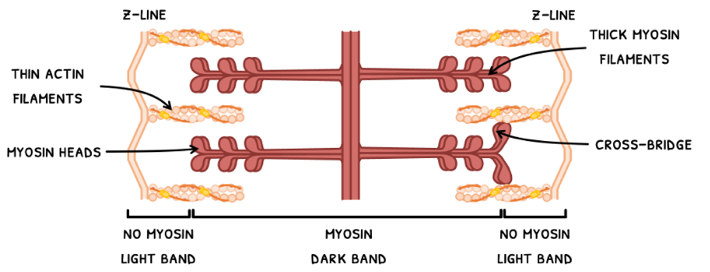
- Z-line – the anchoring outer protein filaments between which the sarcomere lies.
- M-line – the anchoring protein filament in the middle of the sarcomere.
- Actin filaments – thin twisted protein filaments attached at one end to a Z-line.
- Myosin filaments – thick protein filaments attached to an M-line. Each myosin filament contains many heads that bind to myosin binding sites on the actin filaments, forming cross-bridges.
- Tropomyosin – a fibrinous protein on actin filaments that blocks myosin binding sites.
- Troponin – a globular protein on actin filaments that moves tropomyosin to block or unblock myosin binding sites.
- Titin - a fibrous protein that connects myosin filaments to the Z-line. Titin prevents overstretching of the sarcomere and recoils the sarcomere to base position after stretching.
The structure of a sarcomere gives skeletal muscle its characteristics striated banding pattern. Let’s look at the elements of this pattern:
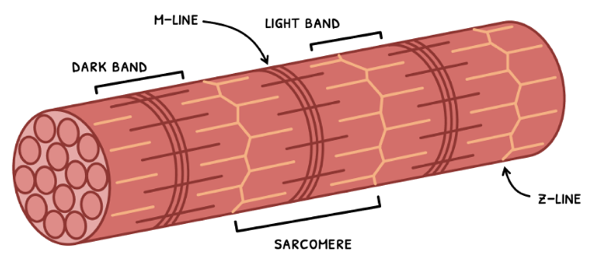
- The dark band – this is the section of the sarcomere where there are myosin filaments. Their density and any overlap with actin filaments give this section a distinctive dark color.
- The light band – this is the section of the sarcomere where there are only actin filaments. Due to the lack of myosin and low density of actin filaments, this section is noticeably lighter in color.