IB Biology Sub-topic D3.3 Notes
This page contains our IB Biology notes for sub-topic D3.3. By reading each one of these notes, you will fully cover the content for IB Biology 'Further homeostasis'.
Loading progress...
Osmoregulation
In the HL syllabus, you need to also know about homeostasis in the context of water and solute concentration, called osmoregulation. Organisms can be classified into two groups based on their level of osmoregulation: osmoregulator or osmoconformer.
- Osmoregulators are organisms that conduct osmoregulation because their solute concentration is different than that of their surroundings. This generally occurs in terrestrial animals and freshwater fish.
- Osmoconformers are organisms that do not conduct osmoregulation because their solute concentration is identical to that of their surroundings. This generally occurs in saltwater organisms.
Correct osmoregulation is very important for proper body function. However, this is sometimes not sufficient to prevent the extremes of water regulation: overhydration and dehydration.
- Overhydration is caused by excessive water consumption or retention without replacing electrolytes. It causes cell swelling and nerve dysfunction, which leads to:
- Headaches and confusion
- Blurred vision and nausea
- Dehydration is caused by excessive water loss or insufficient consumption without replacing electrolytes. It causes decreased muscle function and increased waste, which leads to:
- Dark concentrated urine
- Increased heart rate
- Inability to sweat (which can cause overheating and further dehydration)
Kidney structure
The process of osmoregulation in the kidneys is far more complicated. Let’s start by covering its structure. The kidneys are composed of:
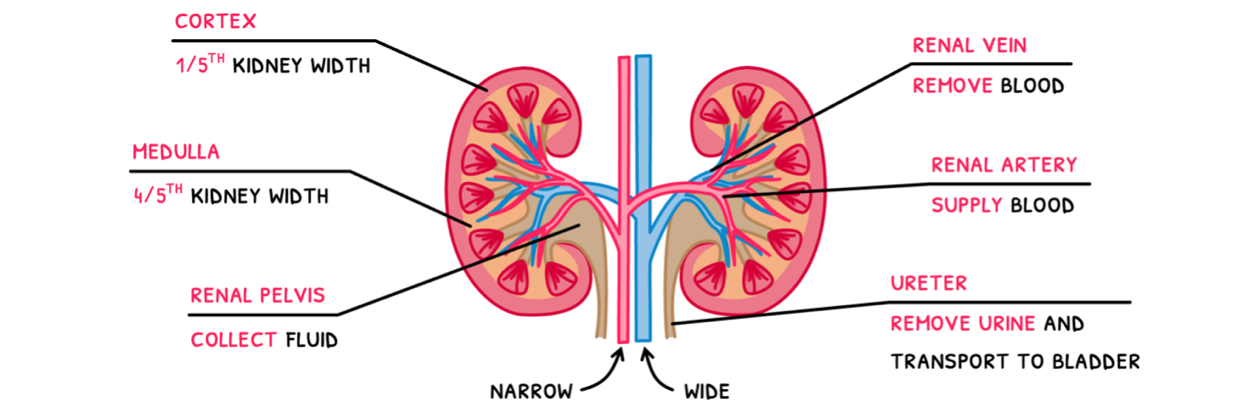
- A renal artery – this supplies blood to the kidney. Remember that arteries have a narrow lumen.
- A renal vein – this removes blood from the kidney. Remember that veins have a wide lumen.
- An outer cortex – a region about 1/5th kidney where mainly solute reabsorption occurs.
- An inner medulla – a region about 4/5th of the kidney where the mainly water reabsorption occurs.
- A renal pelvis – central region of the kidney that collects the resulting urine.
- A ureter – a tube that removes urine from the pelvis and transports it to the bladder.
tibertutor.com
Great Work!
You have now covered all of our sub-topic D3.3 notes, covering "Further homeostasis" for IB biology.
Now that you have completed these IB biology sub-topic D3.3 notes, covering "Further homeostasis", dive into our sub-topic D3.3 flashcards for the IB biology course.
IB biology sub-topic D3.3 flashcards
Explored IB Biology?
Get stuck into one of our other subjects!
Join 85,000 students, across 130+ countries, in 500+ IB schools. That's half of the IB science graduates worldwide.
Start a 7d free trial