IB Biology Sub-topic B3.1 Notes
Gas exchange
Next, you are expected to learn about gas exchange, which is the process by which organisms transfer oxygen and carbon dioxide for respiration or photosynthesis. This is evidently a vital processes in all organisms for them to live. However, as organisms become larger, the SA:V ratio obviously becomes smaller and the distance from the surface to the innermost cells increases.
As a result, multicellular organisms have developed systems for efficient gas exchange, called gas-exchange surfaces.
Most gas exchange surfaces have several properties that make them adapted to perform gas exchange:
- Thin tissue layer - this allows for a short diffusion distance, resulting in rapid diffusion of gases.
- Permeable tissue - allows for diffusion of gases to occur.
- Moist environment - allows for gases to dissolve in the surrounding environment and be present at high concentrations.
- Large surface area - maximises the amount of gas exchange that can occur across the layer.
To facilitate one-way gas exchange, these surfaces also need to maintain concentration gradients. This is often performed by:
- A dense network of blood vessels - these make sure that gas exchange area is maximised and that plenty of CO2 rich and O2 poor blood reaches the surface to maintain the concentration gradient.
- Continuous blood flow - blood flow at the right speed maintains a high internal CO2 concentration that diffuses out and low internal O2 concentration that drive diffusion across the entire length of the surface.
- Ventilation - whether with air in the lungs or water in the gills, a continuous exhalation of carbon dioxide rich air and inhalation of oxygen rich air maintains the concentration gradients needed to keep gases diffusing in the right direction.
Mammalian respiratory system
However, gas exchange surfaces are differently organized in mammals and plants. You are expected to know it in both organisms, starting in mammals. Mammals have a respiratory system wherein gas exchange occurs with the circulatory system to bring in oxygen and take out carbon dioxide
This begins by understanding the anatomy of the respiratory system. The lungs are large air-filled organs in our thoracic cavity, surrounded by:
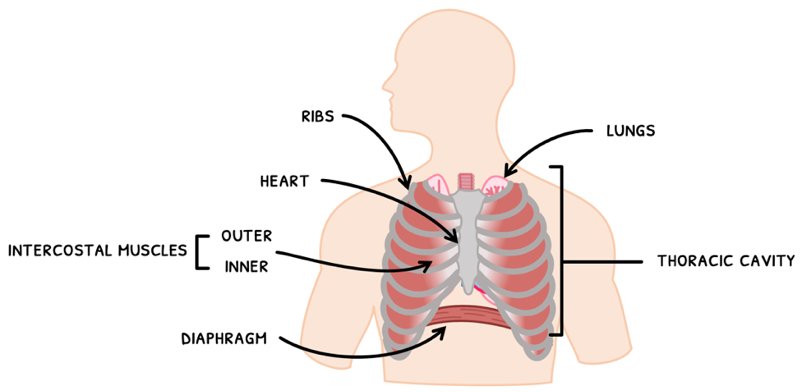
- The diaphragm - a curved muscle below the lungs.
- The heart - nestled between the lungs.
- The ribs - which a form a cage to protect the lungs from trauma.
- Intercostal muscles - between the ribs, separated into an inner and outer layer.
Internally, the important structures of the lungs include:
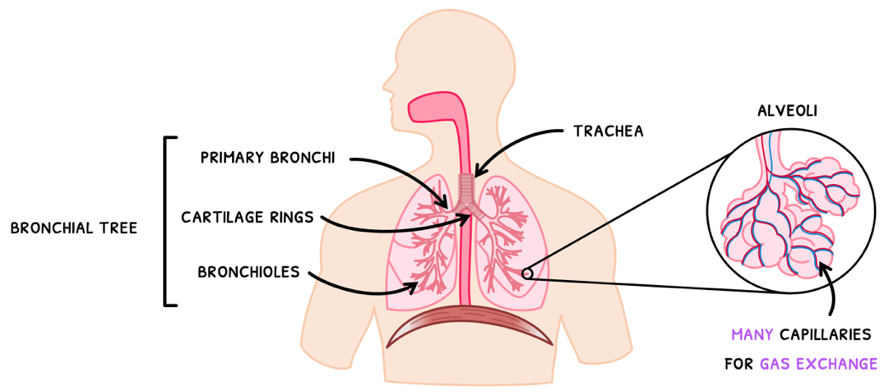
- The trachea - the tube connecting the lungs to the mouth, with cartilage rings to keep them open.
- Primary bronchi - the first division of the trachea into both lungs.
- Bronchioles - the many tubes that branch from the bronchi into the lungs.
- Alveoli - sac-like structures at the end of bronchioles that perform gas exchange.
- Capillaries - surround the alveoli to enable gas exchange in and out of the blood.