IB Biology Sub-topic D3.2 Notes
Genes
Topic D3.2 focuses on inheritance of genes by offspring. Genes are defined as a heritable factor consisting of a length of DNA that influences a specific characteristic. Such an example of a characteristic is hair.
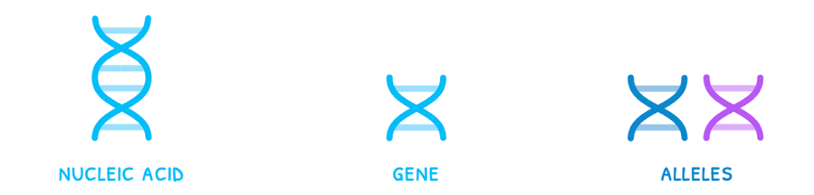
Different versions of this gene are called alleles, which each code for a different version of that characteristics. An example would be that three alleles would code for blonde, brown, or black hair, respectively. However, only one allele can occupy a position on a chromosome, called a locus.
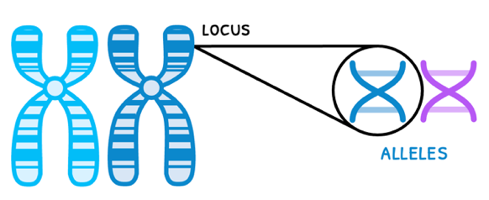
Loci have a specific notation:
- This starts with the number of the chromosome.
- Then, p stands for short arm and q stands for the long arm.
- Lastly, the position of the gene is listed.
For example, the human gene for the hemoglobin β-polypeptide is gene 15.4 on the short arm of chromosome 11. Its notation is thus 11p15.4.
Alleles
Alleles only differ from one another by a few bases due to mutations. You will learn more about these later in this topic. However, it is important to remember that every human only has two alleles, one from their father and one from their mother. You may notice that only one of these alleles actually is expressed.
The phenotype is expressed physical characteristic of an organism. The genotype is all the alleles within an organism that code for this phenotype. The expressed phenotype is thus dependent on the type of allele, of which there are two types:
- Dominant allele - this allele is always expressed.
- Recessive allele - this allele is only expressed in the absence of a dominant allele.
Since there are two alleles, a few combinations are possible. These are split into two major categories:
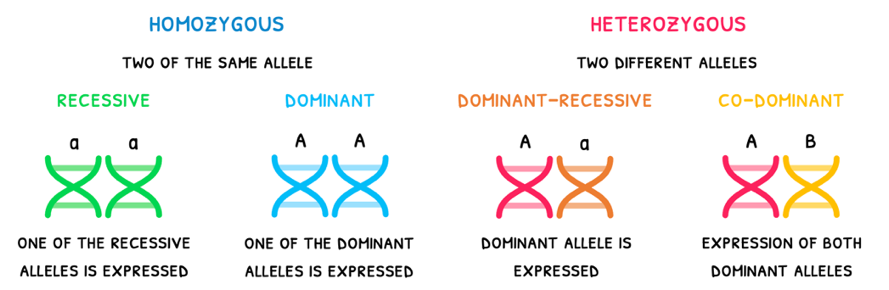
- Homozygous - two of the same type of allele. This is split into two types:
- Dominant - two dominant alleles, resulting in a dominant phenotype.
- Recessive - two recessive alleles, resulting in a recessive phenotype.
- Heterozygous - two different types of allele. This is also split into two types:
- Dominant-recessive - one dominant and one recessive allele, resulting in a dominant phenotype.
- Co-dominant - two different dominant alleles, resulting in both phenotypes being expressed.