IB Biology Sub-topic D3.2 Notes
Segregation
In the HL syllabus, you are expected to understand the inheritance of two genes, called digenic inheritance. In digenic inheritance, the types of genes involved in inheritance affect the end result. There are two main types:
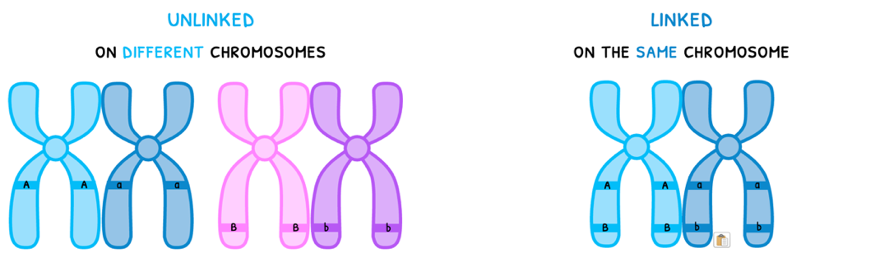
- Unlinked genes are found on different chrosomes. As a result, they separate independently of one another, called independent assortment. As a result, four unique gametes are formed.
- Linked genes are found on the same chromosome. As a result, they separate together, called dependent assortment. As a result, two unique gametes are formed.
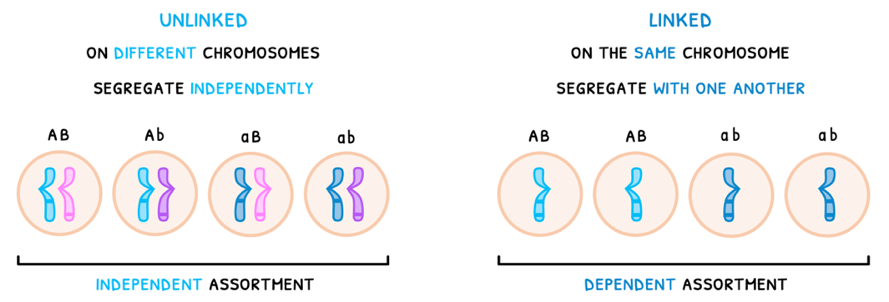
Note that if linked genes are far apart, they may be exchange during crossing over. This results in four unique gametes, making them appear unlinked.
Unlinked genes
You are expected to understand how gene linkage and crossing over impact the resulting digenic inheritance. Let's begin with unlinked genes for heterozygous peas. Here, the allele for a round shape (R) is dominant to wrinkled (r), and a yellow color (Y) is dominant to a green color (y):
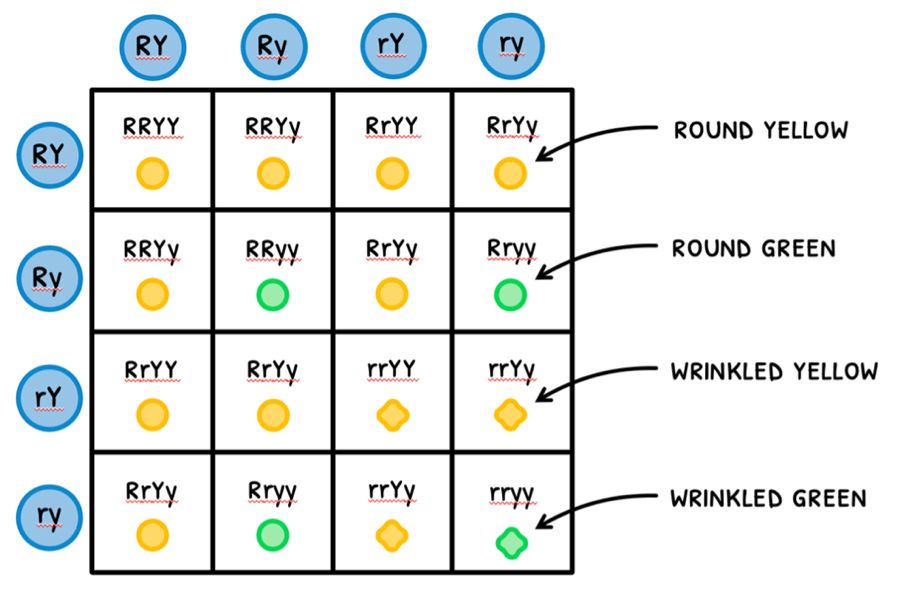
- Draw the four possible gametes of Parent 1 and Parent 2 in circles around the table.
- Then cross-reference them like in Punnett grids to determine the genotype of the offspring.
- Then determine the phenotype of each genotype.
In a heterozygous cross, this results in a phenotype ratio of 9:3:3:1. However, you are also expected to understand the ratio that forms during a homozygous cross. Using the same alleles:
- Draw the four possible gametes of Parent 1 and Parent 2 in circles around the table.
- Then cross-reference them like in Punnett grids to determine the genotype of the offspring.
- Then determine the phenotype of each genotype.
Thus, in a homozygous cross, a phenotypic ratio of 1:1:1:1 is present.