IB Biology Sub-topic B3.2 Notes
Circulatory system
Remember from Topic B2.3 that the surface area-to-volume ratio limits cell size due to supply and waste removal restrictions. To circumvent this issue, organisms use a transport system to provide cells with oxygen and glucose for metabolism, while taking away metabolic waste products.
You need to be aware of this transport system in mammals and plants, primarily focusing on their vasculature.
Human vasculature
In humans, this transport system is the circulatory system – centered around a heart pumping blood through a series of vessels. You are expected to know the structure of these vessels. As you likely know, there are three types of vessels:
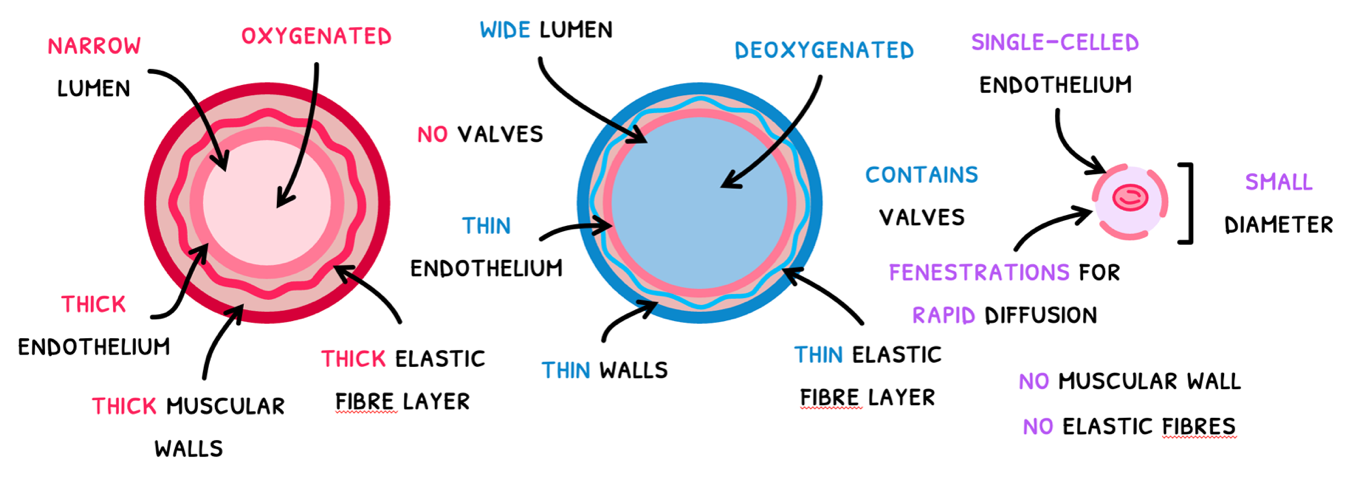
- Arteries – vessels that carry high pressure blood away from the heart. To withstand and maintain these high pressures, they possess a narrow lumen and thick layers.
- Veins – vessels that carry low pressure blood to the heart. To maintain blood blow at these low pressures, they possess a wide lumen and thin layers with valves to prevent backflow.
- Capillaries – small vessels that connect arteries to veins and transport blood to individual cells. To allow substances to easily diffuse in and out, they have a thin endothelium with fenestrations.
Although arteries typically carry oxygenated blood and veins carry deoxygenated blood, remember that this is not always the case due to the double circulatory system.
Coronary occlusion
There are several issues which could cause blood flow in vessels to stop. One of those issues is coronary heart disease, which can lead to coronary occlusions. The process by which this occurs is:
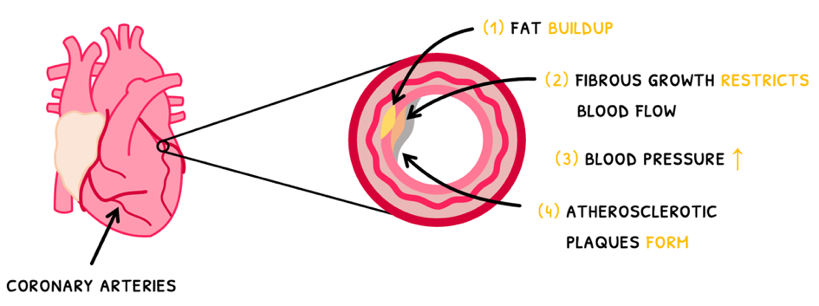
- Excess cholesterol and lipids in the blood lead to fat build-up under the endothelium.
- This damages the vessel and causes fibrous tissue to grow to protect the vessel.
- This growth ends up decreasing the size of the lumen, restricting blood flow and increasing blood pressure.
- This causes further damage and fibrosis, forming atherosclerotic plaques.
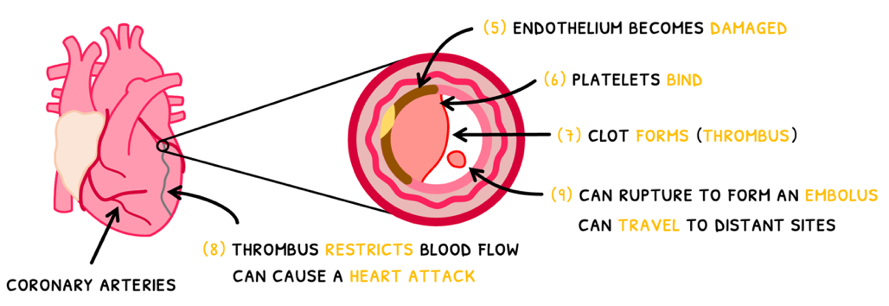
- Over time, blood flow can cause the plaque to come loose and rupture. This can happen in two ways.
- The resulting damage to the endothelium can trigger the recruitment of platelets.
- This trigger the clotting cascade and result in the formation of a clot, called a thrombus. You will learn the details of clotting in Topic 6.3.
- If the plaque completely comes loose, it is called an embolus, which is typically small enough that it travels to smaller vessels.
- Both scenarios involve the formation of a solid that can then get stuck in a downstream coronary artery and restrict blood flow to cardiac tissue. This prevents the tissue from getting oxygen and it begins to die, causing a heart attack.