IB Biology Sub-topic D1.1 Notes
DNA replication
Once DNA's structure was determined, the process of its replication needed to be determined. At the onset, this was tied between three main theories of replication existing at the time:
- Conservative replication - the theory that both parent strands remain together (conserved), and an entirely new duplicate is formed.
- Semi-conservative replication - the theory that the parent strands break apart and each help form a new strand to produce two half-new and half-old copies.
- Dispersive replication - the theory that the parent strands are cut and split up randomly to then produce copies with random amount of old and new DNA.
Meselson and Stahl determined that DNA replication was semi-conservative. You are expected to know this superficially, whilst HL students will learn this process in more detail. It occurs as follows:
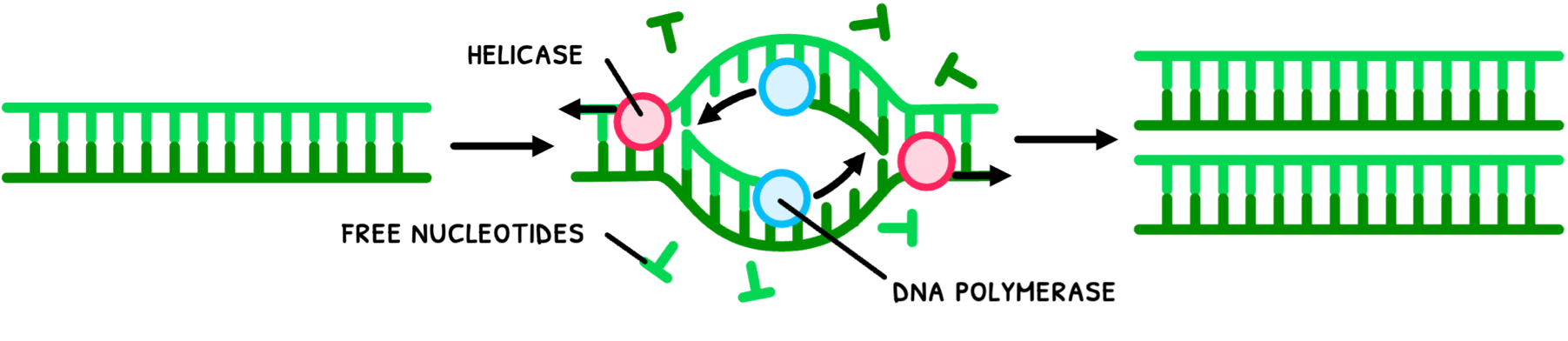
- Helicase unwinds and separates the double helix by breaking hydrogen bonds between DNA strands.
- DNA polymerase links nucleotides to the pre-existing strands via complementary base pairing to form two new identical strands.
- The strands separate and wind back into a double helix.
This method of replication via complementary base pairing has a high accuracy as only certain nucleotides are able to bind to another successfully. Deep knowledge of the process also allows for a number of industrial applications, such as DNA profiling.
DNA profiling
DNA profiling is the analysis of sampled DNA for comparison to other individuals. Although this can be used to determine susceptibility to disease, the applications the IB wants you to be aware of is in crime scene investigations and paternity testing.
In this, samples of DNA are first collected from hair, semen, or blood. However, the amount of DNA present in these samples is insufficient to extensively test and have backups. Therefore, it first requires the polymerase chain reaction (PCR). This is a method of mass artificial DNA replication to generate substantial amounts of DNA for testing from a small sample such as hair or semen. The process is as follows:
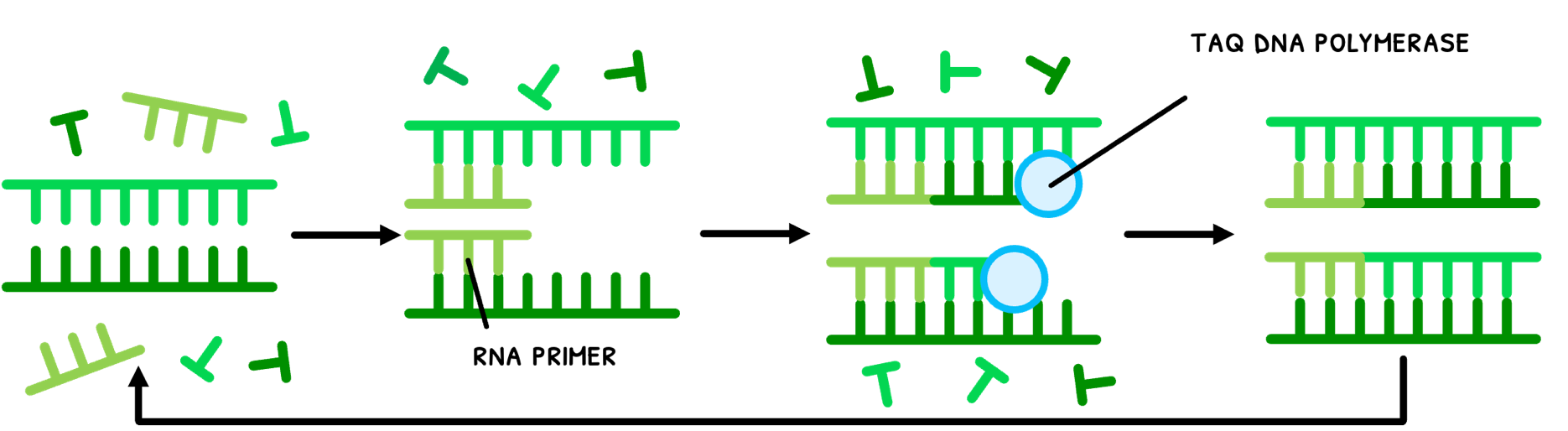
- DNA mixed with primers is heated up to 95°C to split the strands.
- The temperature is lowered to 53°C to allow primers to bind (anneal).
- The temperature is increased to 73°C, the optimal temperature for Taq DNA polymerase to elongate the DNA.
- This process is repeated for a few hours to obtain millions of copies.
You are supposed to appreciate that at the high temperatures of the PCR process, normal human enzymes would denature. However, Taq DNA polymerase does not do this, because it stems from bacteria that live near volcanic vents deep in the ocean that are used to high temperatures. Therefore, the enzyme is not only naturally resistant to these high temperatures, but has its optimal activity there, allowing it to be constantly reused in this process.