IB Biology Sub-topic D1.2 Notes
Non-coding sequences
HL students need to know more details about transcription and translation. Within the concept of gene expression, it is important to understand that the DNA sequences that are transcribed do not only result in proteins. There are several types of DNA sequences:
- Coding DNA - DNA that codes for proteins.
- Non-coding DNA - DNA that does not code for proteins. There are several types:
- Regulators - these promote or repress transcription of adjacent coding sequences.
- Introns - these are used during mRNA processing to aid the splicing of exons.
- Telomeres - the lagging strand loses a little bit of DNA every time it undergoes replication. Telomeres are extra lengths of DNA that prevent the loss of vital DNA.
- tRNA and rRNA production - these sequences are transcribed to form tRNA for translation and rRNA (ribosomal RNA) to form ribosomes.
In this topic, you will learn about about several of these non-coding sequences.
Initiation of transcription
This begins with sequences that regulate gene expression. This means that they regulate the initiation of transcription, which occurs differently in prokaryotes and eukaryotes.
Since prokaryotes do not have nucleosomes to help with regulation, they directly regulate transcription. This is necessary to limit protein production via translation since all proteins are required at different concentrations and at different times, so it would be wasteful to constantly generate them.
In prokaryotes:
- Promotor sequences recruit RNA polymerase to the binding site to initiate transcription.
- However, repressor proteins can bind to DNA at the repressor binding region in response to environmental factors.
- This directly prevents RNA polymerase from performing transcription, thus decreasing the rate of transcription.
In eukaryotes:
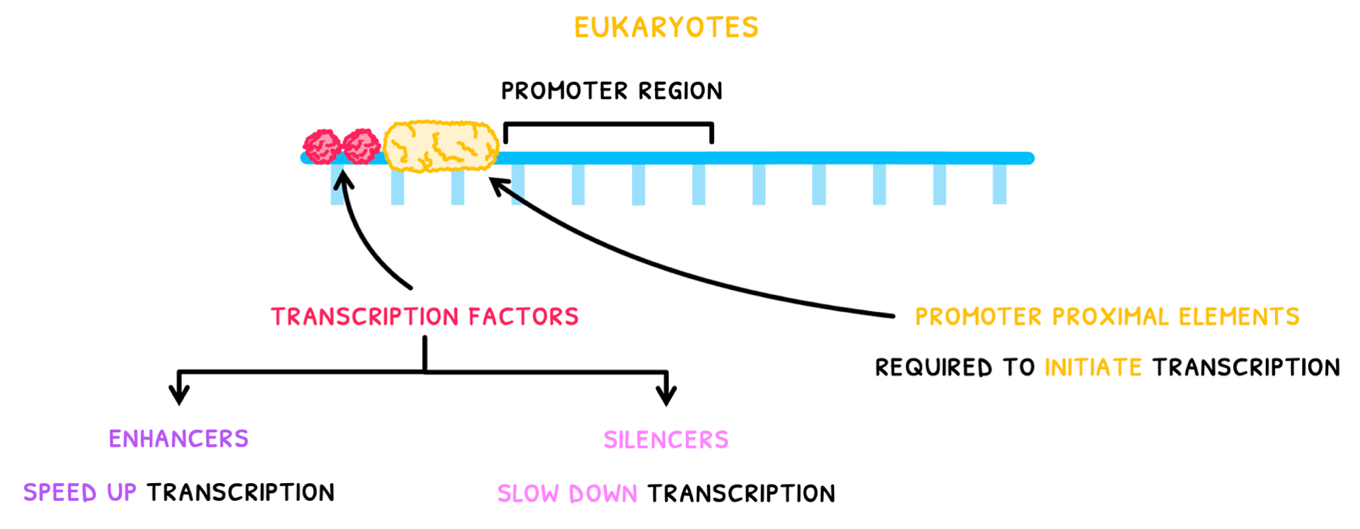
- Promoter proximal elements are present near the promoter region to initiate transcription.
- Transcription factors bind to DNA before the promoter region.
- If these are enhancers, they initiate a cascade of promoter protein recruitment to the promoter region.
- Eventually, this recruits RNA polymerase to the DNA for transcription.
- If silencer factors bind to DNA, they slow down or prevent this process, slowing down transcription.