IB Biology Sub-topic C1.2 Notes
Cell respiration
Remember that cell respiration is the process by which a cell releases energy, in the form of ATP, from its organic compounds. You learned that it is divided into two types: aerobic and anaerobic. In this topic, you will learn about the specific reactions that occur in each type. To summarize:
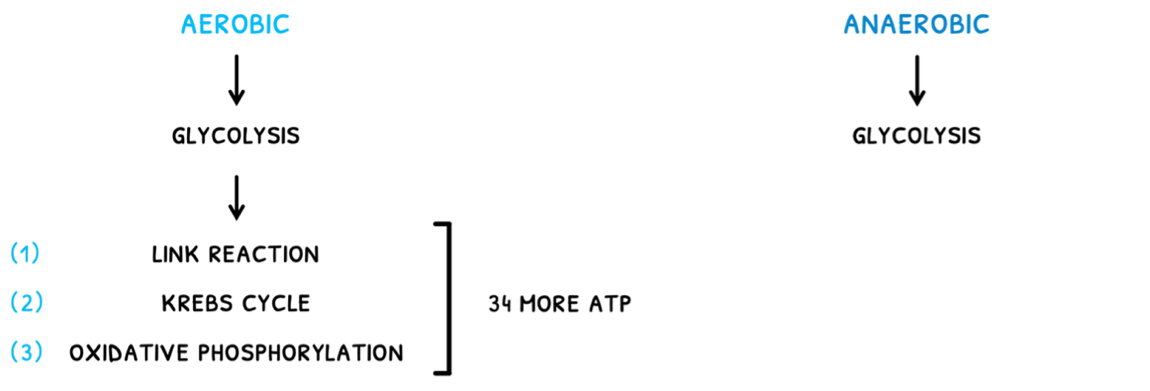
- In anaerobic respiration, only glycolysis occurs.
- In aerobic respiration, glycolysis is followed by the link reaction, Krebs cycle, and oxidative phosphorylation. This ends up producing around 34 more ATP molecules.
Oxidation and reduction
Additionally, to understand what occurs in the reactions it is important to understand two terms: oxidation and reduction.
- Oxidation is the loss of electrons.
- Reduction is the gain of electrons.
However, it is sometimes difficult to see how electrons are transferred, so two alternate definitions can be used:
- Oxidation is the gain of oxygen or the loss of hydrogen.
- Reduction is the loss of oxygen or the gain of hydrogen.
Glycolysis
Now that you know the basics, let's discuss the stages of respiration, starting with glycolysis. In this:
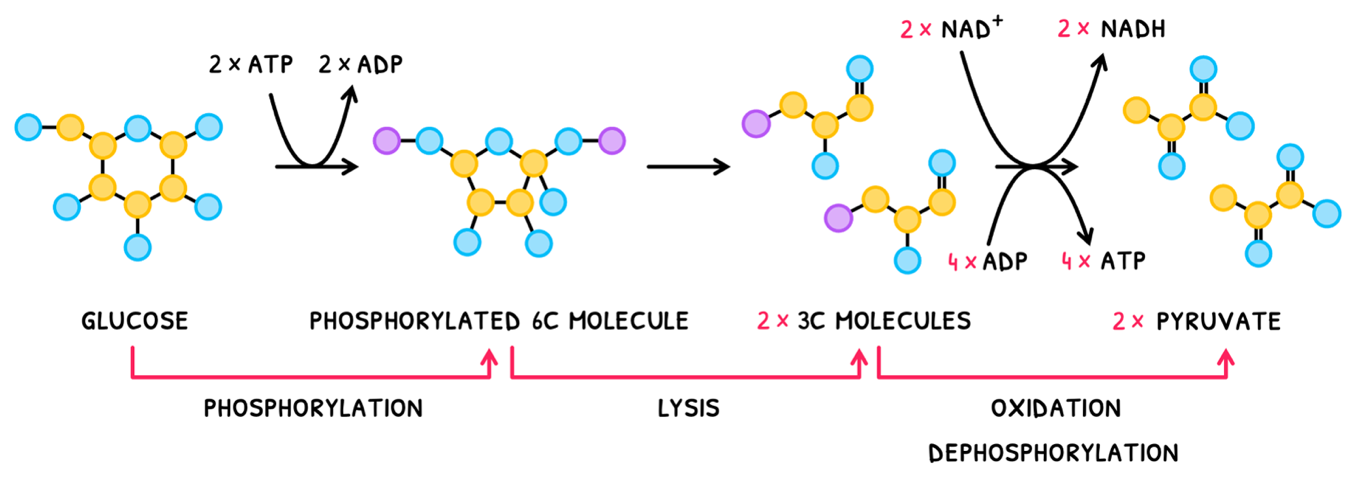
- Glucose is phosphorylated using 2x ATP to form an unstable phosphorylated 6 carbon molecule.
- This unstable phosphorylated 6 carbon molecule then splits by lysis to form 2x 3 carbon phosphorylated molecules.
- Each of these then undergoes oxidation, losing a H to NAD+, which is reduced to form NADH.
- Each also undergoes dephosphorylation, producing 4x ATP total.
The resulting molecule formed is named pyruvate. Therefore, a net 2 NADH, 2 ATP and 2 pyruvates are formed in total. Note the uset of "net" here as 2 ATP were used in the first reaction.