IB Biology Sub-topic B1.2 Notes
Proteins
The next molecular group to cover is proteins. Proteins are a group of molecules composed of carbon, hydrogen, oxygen, nitrogen, and sometime sulfur. For the SL curriculum, you are expected to only understand it has three levels of structure: amino acids, dipeptides, and polypeptides.
Amino acids
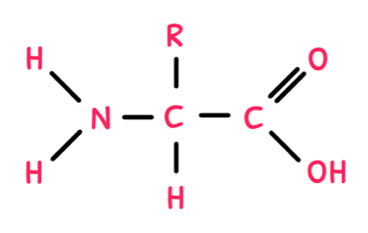
It is easier to think of these levels in comparison to carbohydrates. Just as monosaccharides are the monomers of carbohydrates, amino acids are the monomers of proteins. There are twenty different amino acids, each containing a central carbon bonded to an NH2 (amine) group, a COOH (carboxyl) group, a hydrogen, and an R-group. The R-group is variable, meaning it could be anything from just a hydrogen to a complex side group, and its structure determines the type of amino acid formed.
Collectively, amino acids are used to produce protein, hormones, and enzymes whilst being important in the regulation of digestion and gene expression. Plants are able to synthesise all 20 amino acids, whereas only 11 can be produced naturally by animal cells; these are called ‘non-essential’ as they are not required in the diet. However, the remaining 9 amino acids must be taken in dietarily and as such are referred to as ‘essential’.
| Essential | Non-essential |
|---|---|
| Histidine | Alanine |
| Isoleucine | Arginine |
| Leucine | Asparagine |
| Lysine | Aspartic Acid |
| Methionine | Cysteine |
| Phenylalanine | Glutamic Acid |
| Threonine | Glutamine |
| Tryptophan | Glycine |
| Valine | Proline |
| Serine | |
| Tyrosine |
As vegans do not consume animal foods which are rich in essential amino acids, they must rely on plant-based foods to acquire their essential amino acids. Plant foods often contain some, but not all the essential amino acids and so are incomplete proteins. For example, nuts, beans and grains.
This can be ameliorated by careful combining of plant foods to consider all 9 essential amino acids. For example, the combination of rice and beans provides all 9 essential amino acids.
Peptide bonds
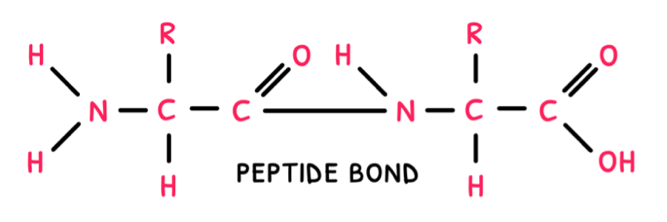
Next, just as disaccharides are composed of two monosaccharides, dipeptides are composed of two amino acids. Same as disaccharides, dipeptides are formed via a condensation reaction and broken down via a hydrolysis reaction. Instead of a glycosidic link, these reactions form or break a peptide bond.