IB Biology Sub-topic D1.2 Notes
Transcription
In Topic A1.2, you learned that nucleic acids code for protein production. Since DNA is located in the nucleus and proteins are produced outside the nucleus, the genetic code needs to be transported out of the nucleus. This done by messenger RNA (mRNA), which is produced by the process of transcription:

- RNA polymerase unwinds the double helix and separates the strands.
- RNA polymerase links nucleotides to one of the pre-existing strands via complementary base pairing (uracil instead of thymine with adenine).
- The mRNA strand separates from the DNA and the DNA pairs up again and twists back into a double helix.
Note that using single DNA strands fixed in the nucleus to nucleosomes as templates provides a very stable base from which to perform transcription. However, the base sequence cannot change so in cells that do not divide, these sequences cannot change throughout the entire life cycle of the cell.
Codons
The generated mRNA then leaves the nucleus is used to produce proteins. In order to do this, there needs to be a conversion of RNA nucleotides to amino acids. The smallest possible combination of four nucleotides that can encode for all 20 amino acids is a triplet code. Four nucleotides and a doublet code could only yield 16 (42) amino acids and four nucleotides and quartet code (44) would code for 256 amino acids.
Thus, the mRNA strand is divided into nucleotide triplets, called codons. There are a total of 64 codon combinations (4 x 4 x 4), shown in the table below.
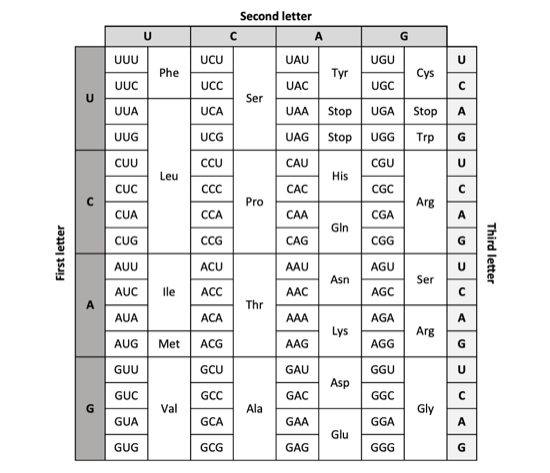
Each codon is associated with an amino acid, but there are only 20 amino acids for 64 codons. This means several codons will exist for the same amino acid, called the degeneracy of the genetic code. However, almost all organisms use the same codons for the same amino acids, called the universality of the genetic code.