IB Biology Sub-topic A1.2 Notes
Hershey and Chase
In the HL syllabus, you need to understand more about nucleic acids. Whilst Watson and Crick discovered the structure of DNA, two other important scientists conducted their own research to determine what genetic material was composed of. These were Alfred Hershey and Martha Chase - who proved that genes are composed of DNA, not protein.
The foundation of their work revolved around the investigation of T2 bacteriophages. These are viruses that infect bacteria and were determined to be composed of:
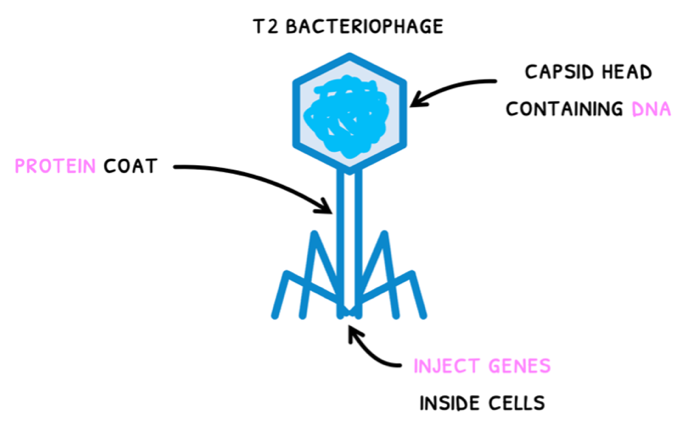
- An outer protein coat with a capsid head and a tube leading to an injection site. Remember that protein contains sulfur, but not phosphate.
- DNA contained inside the capsid head. Remember that DNA contains phosphate, but not sulfur.
It was known that these viruses would use bacteria as their hosts to replicate themselves, like what HIV does in T cells. Questions, however, remained about which element of the bacteriophage was its genetic material. The experiment Hershey and Chase conducted involved:
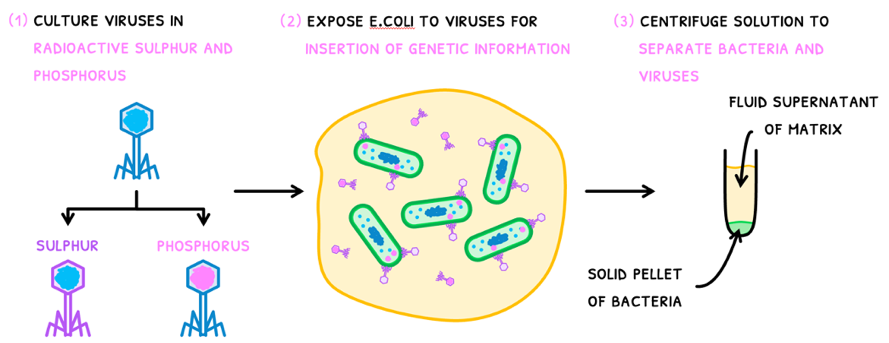
- Culture a group of viruses in radioactive sulfur - giving them a radioactive protein coat. Culture another group of viruses in radioactive phosphate, giving them radioactive DNA.
- Expose E.coli to the viruses for the insertion of genetic information.
- Centrifuge the solution to separate the bacteria and the viruses. This creates two layers:
- A solid pellet of the compacted cells containing the genetic material.
- A fluid supernatant of extracellular matrix that does not contain the genetic material.
Hershey and Chase had the following results:
- The majority of the sulfur's radioactive signature was present in the supernatant, indicating protein was not inserted in the cell.
- The majority of the phosphate's radioactive signature was present in the pellet, indicating DNA was inserted in the cell.
However, some sulfur was present in the pellet and some phosphate in the supernatant. Further research found why this was the case:
- After injection of DNA, some protein coats remained attached to the cells and were thus taken into the pellet.
- Some viruses did not inject their DNA at all, so this content remained in the supernatant.
Explanation of this discrepancy finally concluded that DNA was indeed the genetic material inserted into cells for replication of viruses.