IB Biology Sub-topic C1.3 Notes
Photosynthesis
You learned the basics of photosynthesis, which is the process by which a cell uses light, CO2, and water to generate organic compounds and O2. You learned that this process relies on chlorophyll to split water and use the electrons to produce organic materials. However, you need to learn this process in more detail.
Photosynthesis is typically divided into two stages:
- Light-dependent reactions - in this stage, light is used to split water and drive the phosphorylation of ADP into ATP and the reductiton of NADP into NADPH. This is also called photophosphorylation.
- Light-independent reactions - in this stage, ATP and NADPH are used to fix CO2 to form glucose and other organic compounds. The component of this you need to know is the Calvin cycle.
Light-dependent reactions
Now let's cover the light-dependent reactions. During this, light splits water into oxygen, electrons, and H+ via a process called photolysis. These are then used to phosphorylate ADP into ATP, hence the name photophosphorylation. Like aerobic respiration, this is split into two stages: the electron transport chain and chemiosmis.
However, photosynthesis involves an extra group of enzymes called photosystems. These photosystems are always present in a membrane in cyanobacteria and chloroplasts of photosynthetic eukaryotes to carry out photosynthesis. They are composed of:
- Molecular arrays of chlorophyll - note that using a single chlorophyll molecule would not absorb sufficient energy to perform any part of photosynthesis, but requires an entire array.
- Arrays of other accessory pigments
- A reaction center with a special chlorophyll that emits excited electrons.
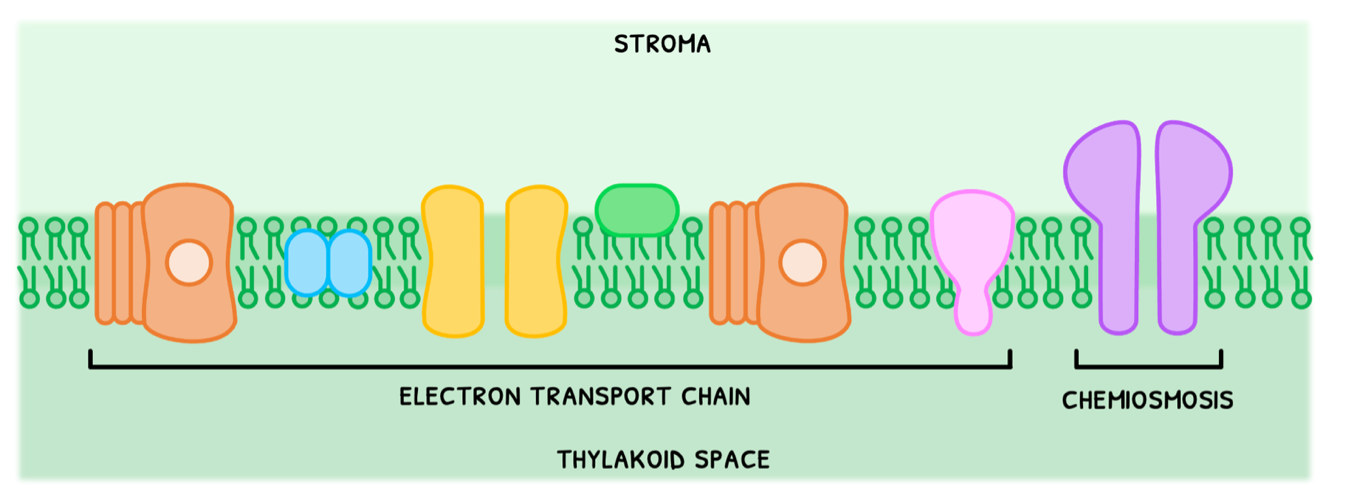
- Electron transport chain - the process by which two photosystems reaction centers absorb light for photolysis, and subsequently donate the electrons to a series of proton pumps to facilitate the build-up of an H+ concentration gradient.
- Chemiosmosis - the process by which the energy from H+ flowing down its concentration gradient is used to phosphorylate ADP into ATP.
Electron transport chain
We can consider the electron transport chain in two halves. In the first half:
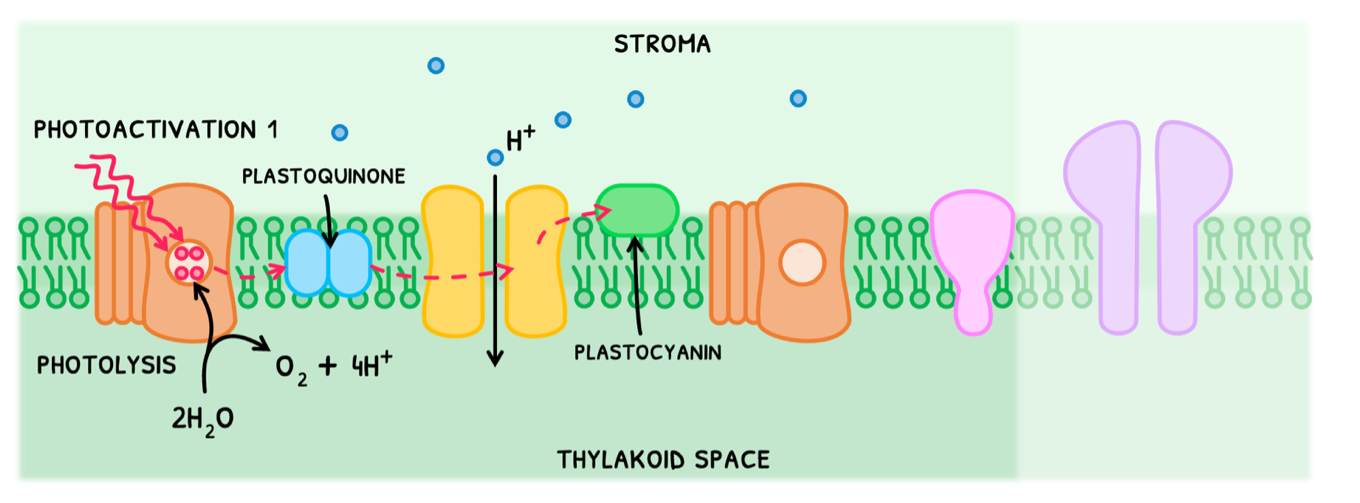
- Photosystem II undergoes photoactivation I, absorbing two photons of light to promote two electrons. This occurs twice to produce four electrons.
- These are donated to an electron acceptor called plastoquinone, reducing it.
- The photosystem now lacks four electrons, making it very reactive. It thus splits water into oxygen, four H+, and four electrons to replenish its electrons.
- Plastoquinone releases its four electrons to the next proton pump, each providing energy to pump one H+ into the thylakoid space.
- Once used, the electrons are accepted by another electron acceptor, known as plastocyanin, reducing it.
This pumps four H+ across and produces four H+ from photolysis, creating a high concentration gradient.